PCB Etching Machine: A Complete Buyer's Guide
A PCB etching machine is the heart of every printed circuit board production line. It removes the unwanted copper from a laminated panel so the circuit pattern defined by the photoresist is left on the board. Buying the right machine affects yield, line capacity, chemistry cost and ultimately the cost per panel. Choose wrong and you fight scrap and downtime for years. Choose well and the line runs steadily for a decade or more.
A PCB etching machine is the heart of every printed circuit board production line. It removes the unwanted copper from a laminated panel so the circuit pattern defined by the photoresist is left on the board. Buying the right machine affects yield, line capacity, chemistry cost and ultimately the cost per panel. Choose wrong and you fight scrap and downtime for years. Choose well and the line runs steadily for a decade or more.
This guide is written for buyers and process engineers who are evaluating a PCB etching machine for the first time, or comparing quotes for a new line. It covers how the machine works, the types available, the specifications that actually matter, what drives price, and how to compare manufacturers.
Quick Answer
- A PCB etching machine sprays heated etchant (usually cupric chloride or ferric chloride) onto masked copper panels to dissolve the exposed copper and reveal the circuit pattern.
- Conveyorised spray etchers are the production standard for medium and high volume; batch and immersion units are used in R&D and small-batch work.
- Key specifications: conveyor width, conveyor speed, etchant temperature control, spray nozzle layout, regeneration system, and fume handling.
- Price is driven by conveyor width, automation level, chemistry regeneration, fume treatment, and whether the line is single or double-sided.
What a PCB Etching Machine Does
The job of the PCB etching machine is selective copper removal. After the inner layers or outer layers of the PCB have been drilled, plated and coated with photoresist, only the copper that forms the actual circuit is protected. Everything else has to come off, down to the substrate, cleanly and evenly across the whole panel. The etching machine delivers fresh, temperature-controlled etchant to the panel and carries it through at a precise speed so the etch depth is consistent from the first panel to the last.
The chemistry depends on the line. Most modern PCB lines use cupric chloride etching because it is fast, regenerable, and gives a clean, vertical sidewall on the copper trace. Ferric chloride is still common in mixed PCB / metal-etching shops and in smaller lines. Either way, the machine's job is the same: deliver the etchant evenly, hold the temperature steady, and remove the dissolved copper as part of the cycle.
Types of PCB Etching Machines
There are three families of PCB etching machines on the market. The right one depends on your production volume, panel size and whether you also etch metals.
1. Conveyor spray etching machine (production standard)
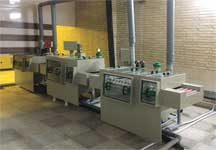
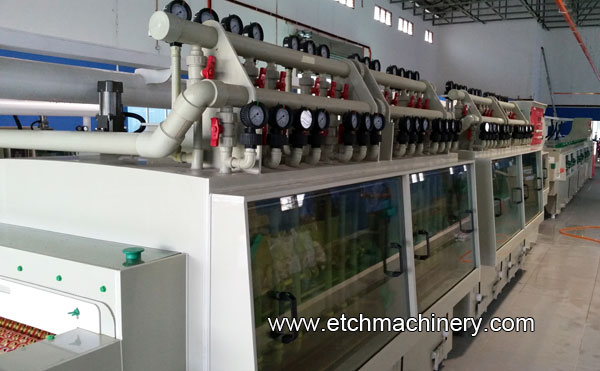
This is the workhorse of any medium to large PCB fab. A horizontal conveyor carries the panel through a sealed cabinet while top and bottom nozzle bars spray etchant onto both faces. Conveyor speed, etchant temperature, spray pressure and nozzle oscillation are all controlled. Capacity scales with conveyor width (typically 400 mm to 1100 mm) and conveyor speed. A modern chemical etching machine in this class will run 24/7 in a production environment with very little operator intervention.
2. Immersion / batch etching tank
Panels are loaded into a heated tank of etchant, often on a rack, and the etchant is moved by bubble agitation or a small pump. Used in prototype shops, R&D labs, and very small batch PCB work. Cheap to buy, slow in production, harder to control etch factor across a large panel. Useful when the same line also processes metal etching samples for trials.
3. Rotary spray etching machine (vertical)
A turntable or vertical-disc machine where panels are spun past stationary spray nozzles. Footprint is small relative to throughput, and the spray action is more uniform than a flat immersion tank. Common in mid-volume PCB and metal nameplate production where floor space is tight.
| Type | Best for | Capacity | Footprint | Typical price band |
|---|---|---|---|---|
| Conveyor spray | Medium–large fabs | High | Large | High |
| Immersion / batch | Prototype, lab, very small batch | Low | Small | Low |
| Rotary spray | Mid-volume, nameplate / mixed shop | Medium | Compact | Medium |
Key Specifications to Compare
Two PCB etching machines that look similar in a brochure can perform very differently on the line. These are the specifications that actually move the needle on quality and capacity.
Conveyor width and panel size
Conveyor width is the dominant specification because it sets the maximum panel size. A 400 mm line handles most single-panel prototype and small-batch work; 600 mm lines cover most double-sided panel PCB work; 800 mm and up handle the larger panel formats used in LED, FR4 and aluminium-PCB production. Buying a line that is just wide enough is a false economy — it constrains what jobs you can take on.
Etchant temperature control
Etch rate is highly temperature-sensitive, and an unstable bath is the most common cause of inconsistent line width across a panel. Look for heaters with proportional control (not just on/off thermostats) and a tank with good thermal mass. A regeneration system that adds oxidant and adjusts pH automatically is even better, because the etch rate stays flat through a long run.
Spray nozzle layout and oscillation
Even etchant coverage is the difference between a clean, vertical sidewall and a ragged, undercut one. Flat-fan nozzles, full-coverage manifolds and an oscillating spray bar eliminate the dark stripes that show up when one area of the panel is starved of fresh etchant. The number of nozzles and the oscillation pattern is worth reading in detail on the spec sheet.
Conveyor speed and drive
A variable-speed drive lets the operator slow the line for thick copper or speed it up for thin layers. Look for a digital readout and a clear speed control, not a stop-and-go manual knob. Smooth acceleration and braking prevents wet panels from shifting on the conveyor, which is a common cause of mis-etched panels.
Fume extraction and wash / dry section
Acid mist is a real safety and environmental issue. Any production PCB etching machine should be supplied with a matched fume hood and scrubber, and the conveyor line should include a clean-water rinse and an air-knife dryer at the exit. Skipping the dryer means panels come out spotted; skipping the rinse leaves etchant residue that ruins the next process step.
Don't confuse conveyor width with chamber length. A wide, short chamber runs high volume of small panels; a long, narrow chamber is for long, narrow parts. Both numbers matter.
What Affects PCB Etching Machine Price
PCB etching machine price varies more than most buyers expect. A small bench-top unit can be a fraction of the cost of a full production line, and the gap is not just brand — it is specifications.
- Conveyor width and panel size capacity. Doubling the working width typically adds 40–80% to the price.
- Single-side vs double-sided etching. A double-sided line needs top and bottom spray, alignment fixtures, and more sophisticated nozzle control, and costs more for the same panel size.
- Material of construction. Polypropylene (PP) housings are standard. PVC, CPVC and PVDF are used for hot, aggressive chemistry and add cost.
- Automation and control. Manual control panels keep the price down; PLC + HMI + recipe storage add cost but pay back fast in a production line.
- Etchant regeneration system. Inline regeneration with oxidant dosing and specific gravity control is a real cost driver, but it saves a lot in chemistry and downtime.
- Fume treatment. A packed-tower scrubber sized for the line is a meaningful part of the total package; some manufacturers include it, others quote it separately.
- Spare parts, training and commissioning. A machine quoted "EXW" can be 15–25% cheaper than the same line delivered, installed and commissioned. Always compare on the same basis.
How to Compare PCB Etching Machine Manufacturers
Price is the easy part of the comparison. The harder part is whether the supplier will still be in business, still answering the phone, and still be able to ship a spare part five years from now. A few things separate a real manufacturer from a trading company.
- Do they own a fabrication shop, or are they reselling someone else's machine?
- Can they show you a working line on a video call or invite you to a reference customer?
- Do they hold stock of common spares (pumps, nozzles, heaters, seals)?
- Do they publish a clear warranty period, response time and remote-support capability?
- Will they put a process engineer on the line for installation and commissioning?
A PCB etching machine is a long-life asset. Treat the manufacturer selection with the same care you would give a deposition or plating line supplier.
Common Mistakes When Buying a PCB Etching Machine
Most first-time buyers make at least one of these. None of them are fatal, but they are expensive to fix later.
- Under-sizing the conveyor width to save 15% on price, then finding that two-thirds of incoming orders do not fit.
- Skipping the regeneration system to reduce upfront cost, then spending the saving on extra chemistry in year one.
- Buying a single-sided line for a process that will move to double-sided panels in 18 months.
- Specifying manual controls to cut the budget, then watching the line slow down because every speed change needs an operator.
- Forgetting the rinse and dry sections in the spec, then having to add them in a second installation.
Spec'ing a PCB Etching Machine?
Send us your panel size, copper thickness, expected volume and target chemistry. Golden Eagle will spec a conveyor etcher, regeneration system and fume treatment to match.
Request a QuotationConclusion
A PCB etching machine is a long-term capital decision, not a transactional purchase. The right conveyor width, the right nozzle system, the right regeneration package and a manufacturer who will support the line for ten years are worth more than a 10% saving on the invoice. Get those right and the line will run clean, stable, profitable copper etching for the next decade.