
How Does a Chemical Etching Machine Work?
A chemical etching machine looks simple from the outside — a long enclosed cabinet with a sheet going in one end and a finished part coming out the other. Inside, it is doing something quite precise: spraying a heated acid onto a masked metal or PCB sheet so that the exposed areas dissolve away by a few microns at a time, while the protected areas stay untouched. Get the spray, heat and timing right and you get clean, repeatable parts. Get them wrong and you get uneven depth, ragged edges, or wasted chemistry.
A chemical etching machine looks simple from the outside — a long enclosed cabinet with a sheet going in one end and a finished part coming out the other. Inside, it is doing something quite precise: spraying a heated acid onto a masked metal or PCB sheet so that the exposed areas dissolve away by a few microns at a time, while the protected areas stay untouched. Get the spray, heat and timing right and you get clean, repeatable parts. Get them wrong and you get uneven depth, ragged edges, or wasted chemistry.
Here is what is happening inside the cabinet, part by part, and what actually controls the result.
Quick Answer
- A chemical etching machine sprays heated etchant onto a masked sheet as it rides through an enclosed chamber on a conveyor. The etchant dissolves the bare metal; the photoresist protects the rest.
- Four things decide the result: spray pressure, etchant temperature, etchant concentration, and conveyor speed.
- A regeneration system keeps the etchant at strength so the etch rate stays steady through a long production run.
What a Chemical Etching Machine Does
The job is selective metal removal. Before the sheet ever reaches the etcher it has been coated with photoresist and imaged, so a mask now covers everything that should remain metal. The chemical etching process then removes the unprotected metal. The machine's whole purpose is to deliver fresh etchant to that bare metal evenly, hold it at the right temperature, and carry the sheet through at a speed that gives exactly the depth you want — across the full width of the panel, sheet after sheet.
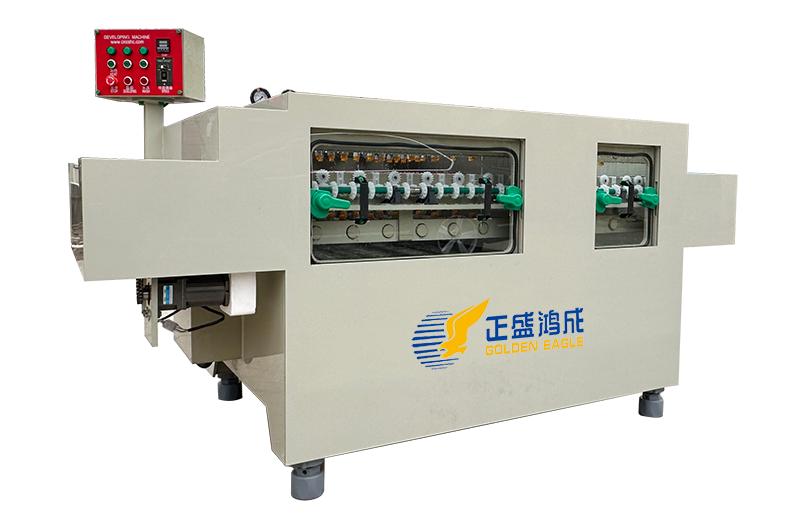
Inside a Spray Etching Machine: The Main Parts
Almost all production etchers are horizontal, conveyorised spray machines. The core parts are the same whether the line etches copper for PCBs or stainless steel for nameplates:
- Etch chamber. A sealed cabinet built from acid-resistant plastic (PP or PVC) where the spraying happens. It contains the mist and keeps the chemistry off everything else.
- Spray manifolds and nozzles. Banks of nozzles above and below the conveyor fan etchant across both faces of the sheet at once. The nozzle pattern and spacing decide how even the coverage is.
- Conveyor. Acid-proof rollers or wheels carry the sheet through at a set, adjustable speed. Conveyor speed is the main depth control.
- Sump and pumps. A reservoir holds the etchant; pumps recirculate it from the sump up to the nozzles continuously.
- Heater and temperature control. The etchant is held inside a working window — for ferric chloride that is often around 45–55 °C — because etch rate rises and falls with temperature.
- Oscillation. The nozzle bars usually sweep side to side so no part of the sheet sits in a stripe between two nozzles.
- Fume extraction. A duct draws acid mist out of the chamber to a scrubber, protecting operators and the room.
- Rinse and dry sections. Downstream of the etch chamber, water sprays rinse the sheet and air knives dry it before it exits.
The Etching Cycle, Step by Step
- Load. The masked sheet enters the chamber on the conveyor.
- Spray etch. Top and bottom nozzles flood both faces with heated etchant. Fresh solution keeps hitting the surface and washing away spent etchant and dissolved metal, so the reaction never slows down at the surface.
- Etch to depth. Conveyor speed sets how long the sheet stays under the spray, and that dwell time sets how deep the etch goes — part-way for relief, or all the way through for cut-out parts.
- Rinse. Water sprays wash residual etchant off the sheet so the reaction stops cleanly.
- Dry. Air knives or blowers dry the sheet.
- Unload. The etched sheet exits the far end, ready for resist stripping and inspection.
Spray Etching vs Immersion (Tank) Etching
You can also etch by simply dipping a sheet in a tank of etchant, and small workshops and labs still do. But immersion is slow and uneven: as the metal dissolves, a layer of spent, metal-loaded solution clings to the surface and chokes the reaction. Spray etching solves that by constantly throwing fresh etchant at the surface and clearing the spent layer, which is why every high-throughput line uses it.
| Factor | Spray Etching | Immersion (Tank) Etching |
|---|---|---|
| Etch speed | Fast | Slow |
| Evenness | Even — fresh etchant always at the surface | Uneven — slows as spent solution builds up |
| Edge / undercut control | Good and repeatable | Harder to control |
| Throughput | Continuous, conveyorised | Batch, one load at a time |
| Best for | Production PCB and metal etching | Simple, small-batch or lab work |
The Four Controls That Decide Etch Quality
A spray etcher gives you four knobs, and good parts come from holding all four steady:
- Spray pressure. Too low and the etch is slow and patchy; too high and you waste energy and can blur fine features. Even coverage across the panel matters more than raw pressure.
- Temperature. Every etchant has a working window. Warmer etches faster, but only up to a point, and any drift in temperature shows up as a drift in line width and depth.
- Etchant concentration. As the etchant dissolves metal it loses strength. Concentration — and on copper lines the oxidation-reduction potential (ORP) — is monitored and topped up to keep the rate constant.
- Conveyor speed. This sets dwell time under the spray, which sets etch depth. Slower means deeper. It is the simplest day-to-day adjustment on the line.
Keeping the Etchant Alive: Regeneration
Etchant does not last forever on its own. As it fills with dissolved metal it etches more slowly and eventually stops. An etchant regeneration system re-oxidises the solution so its strength stays constant, and on cupric chloride lines it also recovers the copper. The payoff is a stable etch rate over long runs, lower chemical use, and less waste to treat. On simpler ferric chloride lines the bath is replenished and topped up to stay in range. Either way, the choice of etchant and how it is maintained matter as much as the machine itself.
One Face or Two, and Matching the Machine to the Work
Most production etchers spray top and bottom at the same time, so a double-sided PCB or a part etched from both faces is done in one pass. Single-sided jobs simply mask or protect the back. Beyond that, the machine is sized to the work: panel width, single or double sided, the etchant chemistry, whether regeneration is needed, and the throughput you are after. A small PCB etching machine for a prototype lab and a wide metal etching machine for production signage share the same working principle but are built to very different scales.
Need the Right Etching Machine for Your Parts?
Tell us your material, panel size and volume — Golden Eagle will spec the etcher, the etchant and the regeneration to match.
Talk to an EngineerConclusion
A chemical etching machine is, at heart, a controlled way to spray fresh, heated etchant onto bare metal and clear it away before it can slow down. The chamber, nozzles, conveyor, heater and pumps all exist to keep that spray even and the temperature steady, while conveyor speed and a regeneration system keep depth and etch rate repeatable. Match the machine and the chemistry to your material and volume, and the same simple principle delivers everything from fine PCB tracks to deep-etched metal signs.