
Spray Etching Machine vs Immersion Etching: Which One to Choose?
Both spray etching machines and immersion etching tanks do the same job — dissolve exposed metal with a chemical etchant — but they deliver the etchant in fundamentally different ways. That difference changes the etch rate, the sidewall quality, the chemistry consumption and the cost per part. Picking the wrong one is one of the most common mistakes new etching shops make.
Both spray etching machines and immersion etching tanks do the same job — dissolve exposed metal with a chemical etchant — but they deliver the etchant in fundamentally different ways. That difference changes the etch rate, the sidewall quality, the chemistry consumption and the cost per part. Picking the wrong one is one of the most common mistakes new etching shops make.
This article walks through how each approach works, where each one wins, and a simple decision rule for choosing the right machine for your application.
Quick Answer
- Spray etching machines pump etchant through nozzles onto the surface of the part. Higher etch rate, better etch factor, lower chemistry use. The production standard.
- Immersion etching dips the part into a tank of etchant, often with air agitation. Lower equipment cost, slower etch, less uniform on large panels. Used in prototype and lab work.
- Choose spray for production (any serious volume, large panels, tight tolerances). Choose immersion for prototype, very small batch, or where the same line must also process samples and parts of mixed size.
How a Spray Etching Machine Works
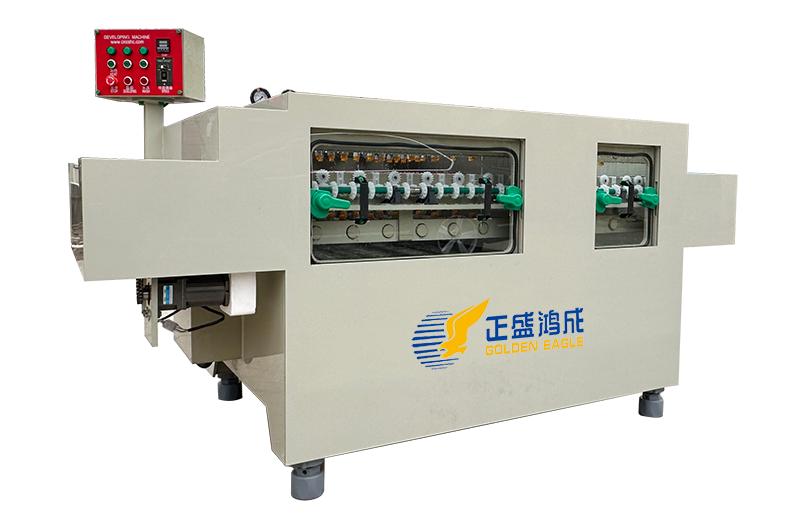
A spray etching machine (also called a spray etcher or conveyorised sprayer) pumps etchant from a sump up to one or more banks of spray nozzles mounted above and below the workpiece. The nozzles fire a flat-fan pattern of liquid onto the surface at relatively low pressure (typically 1–3 bar). The workpiece passes through the spray zone on a conveyor, or the nozzle bar moves across a stationary part, while the spray continually refreshes the chemical at the etch front.
The three things that make spray etching faster and more uniform than immersion are fresh etchant, mechanical impact and oxygen renewal. Fresh etchant arrives at the surface continuously, so the local concentration does not fall. The droplets physically knock dissolved metal and reaction byproducts off the surface. And the spray re-aerates the etchant, which matters for chemistry that needs oxygen to keep working (ferric chloride in particular).
How an Immersion Etching Machine Works
An immersion etcher is essentially a heated, agitated tank of etchant. The part is loaded on a rack, a carrier or a fixture and lowered into the bath. Etching happens because the part is in contact with the etchant. Without spray, the only thing moving fresh chemistry to the surface is natural convection, air agitation, bubble agitation, or a slow recirculation pump.
The result is a slower etch and a less uniform etch across a large panel. The local etchant concentration drops at the etch front, by-products build up, and the sidewall quality suffers — etch factor drops, undercut increases. The advantages are real though: the equipment is simple, cheap, and very flexible for small batches and mixed parts.
Side-by-Side Comparison
| Factor | Spray etching machine | Immersion etching |
|---|---|---|
| Etch rate | High (typically 2–4× faster) | Low to moderate |
| Etch factor (sidewall quality) | Good to excellent | Fair; undercut higher |
| Etchant consumption | Lower (chemistry refreshed, not dumped) | Higher (bath turnover) |
| Uniformity on large panels | Excellent with oscillating nozzles | Uneven, especially on large panels |
| Equipment cost | Higher | Low |
| Footprint | Larger (conveyor line) | Small (single tank) |
| Best production volume | Medium to high | Prototype, lab, very small batch |
| Maintenance | More parts (pumps, nozzles, conveyor) | Simple; mostly tank and heater |
Etch Quality: Why Spray Almost Always Wins
The most important difference for production is the etch factor. Etch factor is the ratio of etch depth to undercut — the higher the better, because the sidewall is closer to vertical and the line width matches the artwork. In a well-tuned spray etcher, etch factors of 5:1 and better are routine. In a still immersion tank, etch factors closer to 2:1 or 3:1 are common, and they vary across the panel.
The reason is boundary layer. At the surface of the metal there is a thin layer of liquid where the etchant has been depleted and the dissolved metal has accumulated. In spray etching, droplets constantly disrupt that layer. In immersion, the layer just sits there, slowing the etch and letting undercut grow. That is why a chemical etching machine in a production line is almost always a spray etcher, not a tank.
Chemistry and Operating Cost
Spray etching machines use less chemistry per square metre etched for two reasons. First, the etch is faster, so the panel is in the bath for less time. Second, the closed loop in a conveyor line with regeneration recirculates the etchant and tops it up with oxidant and makeup chemistry, instead of dumping and replacing the bath. A well-designed spray line can cut chemistry consumption by 30–50% compared to an immersion tank of equivalent throughput.
The trade-off is in the utilities. A spray etcher uses pump power, exhaust ventilation and PLC control. An immersion tank uses a small heater and maybe a bubbler. For a single tank running one panel a day, the immersion line wins on power. For anything more than that, the spray line's higher throughput and lower chemistry cost pay the utilities back.
When Immersion Still Makes Sense
Immersion is not dead. There are real situations where it is the right answer:
- Prototype and R&D work. A small heated tank with a bubbler is enough to develop a process and to make a few panels a day.
- Very small batch PCB and metal nameplate work where volume does not justify a conveyor line.
- Schools, training labs and demonstration setups where simplicity and visibility matter more than throughput.
- Depth etching and chemical milling of large or unusually shaped parts that would be hard to handle on a conveyor.
- Backup capacity in a fab that primarily uses a spray line, for overflow or for parts that are awkward to convey.
When Spray Is the Only Real Answer
If you are doing any of the following, a spray etching machine is the only practical option:
- Production PCB, single or double-sided, at any meaningful volume.
- Metal nameplate, sign, decorative panel or filter mesh work at commercial volume.
- Etched metal thickness above 0.5 mm, where the etch time in an immersion tank is uneconomic.
- Etched line width and pitch that require a clean, vertical sidewall (electronics, fine filters, RF shielding).
- Work that needs to be done today, with consistent results, by the same operator every shift.
Not Sure Which Type Fits Your Job?
Tell us the part, the metal, the etch depth and your monthly volume. We will recommend a spray, immersion, or rotary system that matches.
Get a RecommendationThe Decision Rule
A simple way to think about it: if your volume is more than a few square metres of panel a day, or your tolerances are tight, or your panels are large, choose a spray etching machine. If you are running a prototype lab, a school, or a job shop doing one-off custom parts, a well-set-up immersion tank still does the job and keeps the capital cost down.