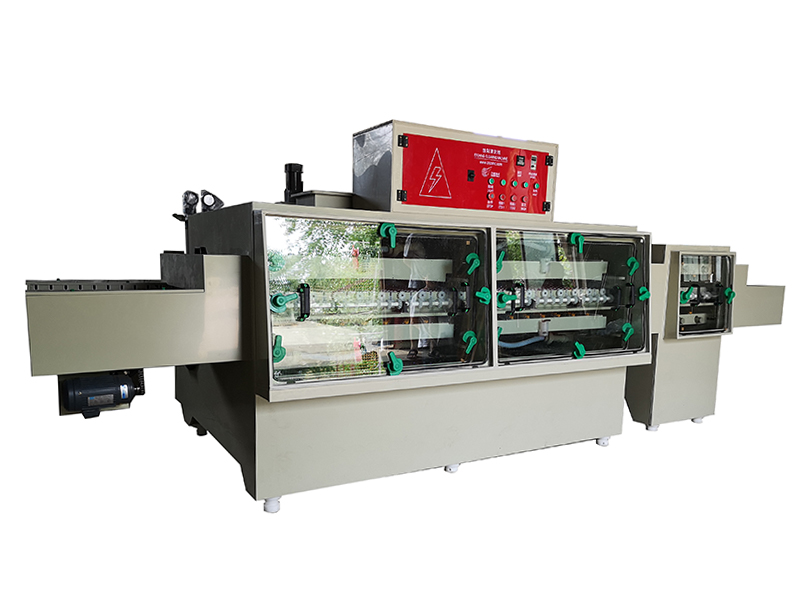
Conveyor Etching Machine: How It Works and Why It Is the Industry Standard
If you have ever walked through a PCB fab or a metal nameplate factory, the line you saw was almost certainly a conveyor etching machine. The conveyorised spray etcher has been the production standard for over forty years, and for good reason: it is the only design that combines high throughput, repeatable etch quality and reasonable floor space at the same time. Once you understand how a conveyor etcher is built, most of the things that look like magic in a brochure suddenly make sense.
If you have ever walked through a PCB fab or a metal nameplate factory, the line you saw was almost certainly a conveyor etching machine. The conveyorised spray etcher has been the production standard for over forty years, and for good reason: it is the only design that combines high throughput, repeatable etch quality and reasonable floor space at the same time. Once you understand how a conveyor etcher is built, most of the things that look like magic in a brochure suddenly make sense.
Quick Answer
- A conveyor etching machine moves parts through a sealed chamber on a powered conveyor while top and bottom spray bars deliver heated etchant to both faces.
- It is the production standard for PCB, metal nameplate, sign, filter, decorative panel and chemical milling work above small batch volumes.
- Capacity scales with conveyor width and speed — typical lines run 400 mm to 1100 mm wide, at 0.5 to 6 m/min.
- It works because three things happen at once: fresh etchant keeps arriving, dissolved metal is washed away, and temperature is held constant.
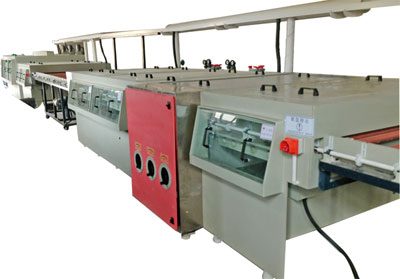
What a Conveyor Etching Machine Is
A conveyor etching machine is a horizontal, conveyorised spray etching line. Parts are loaded onto a powered conveyor at the entry end, travel through one or more sealed spray chambers, and exit at the other end rinsed and dried. Inside the chamber, banks of nozzles above and below the conveyor spray etchant at the parts from both sides. The conveyor speed, etchant temperature, spray pressure and nozzle oscillation are all adjustable.
It is the design that lets a single operator run hundreds of square metres of panel a day. Nothing else combines that throughput with the etch quality a modern PCB or metal etching line demands.
Anatomy of a Conveyor Etching Machine
A typical conveyorised spray etching line is built from the same set of modules, whether the line is for copper-clad PCB panels or for stainless steel nameplates. Knowing what each module does makes it much easier to compare one manufacturer's line to another.
1. The conveyor and frame
The frame is heavy-gauge steel, fully welded and corrosion-protected. The conveyor is usually a chain drive with acid-resistant rollers or wheels that support the panel as it travels through the chamber. The drive is a variable-frequency motor so the line speed can be set exactly, with smooth acceleration and braking to keep wet panels from sliding.
2. The etch chamber
The chamber is built from polypropylene (PP), PVC or PVDF — plastic that survives constant exposure to hot, oxidising acid. It is divided into one or more zones (pre-etch, main etch, post-etch rinse) so each step is its own controlled environment. The chamber contains the spray, the mist and any splashing, and it is the structural shell that everything else hangs off.
3. The spray bars and nozzles
Above and below the conveyor, banks of flat-fan nozzles are mounted on spray bars. The bars usually oscillate slowly side to side so that no point on the panel sits in a stripe between two nozzles. A typical production line has dozens of nozzles per bar, all fed from a common manifold. The nozzle pattern, the spray angle and the spacing decide how even the etch is.
4. The sump, pumps and heaters
Etchant collects in a sump beneath the chamber. Pumps (usually magnetic-drive, all-plastic so there is no metal to corrode) lift it from the sump up to the spray bars. Heaters — often quartz or titanium — bring it up to the working temperature and hold it there. For ferric chloride this is around 45–55 °C; for cupric chloride the working window is tighter and a chiller may be needed to remove excess heat.
5. The regeneration system
As the etchant does its job, dissolved metal builds up in the bath and the active ingredient is consumed. A regeneration system doses the bath with oxidant (chlorine gas, hydrogen peroxide or sodium chlorite, depending on the chemistry) and water to keep the etch rate constant. Without regeneration, the etch slows down through a long run and panels at the end of the shift come out under-etched. With regeneration, the etch rate is flat from the first panel to the last.
6. Fume extraction and scrubber
Hot acid gives off mist. A fume hood on top of the etch chamber pulls that mist away from the operator and sends it to a scrubber, typically a packed-tower scrubber with sodium hydroxide solution. The scrubber neutralises the acid and the cleaned air goes up the stack. No conveyor etching machine should be run without a properly sized fume system, both for safety and to meet environmental rules.
7. Rinse and dry sections
At the exit end, the conveyor carries the panel through a clean-water rinse chamber and an air-knife dryer. The rinse stops the etch exactly where it should stop and washes the residual chemistry off the panel. The air knife blows the water off so the panels come out dry and ready for the next step. Skipping the dryer means water spots; skipping the rinse means etchant contamination downstream.
How a Conveyor Etching Machine Works, Step by Step
- The operator loads masked panels onto the conveyor at the entry end.
- Variable-speed drive pulls the conveyor through the chamber at the speed set for the chemistry, copper thickness and etch depth.
- Inside the etch chamber, top and bottom spray bars deliver fresh, heated etchant to both faces of the panel. Nozzle bars oscillate for even coverage.
- Etchant dissolves the exposed copper or metal; the dissolved metal is carried back into the sump.
- Regeneration system continuously tops up the active ingredient and water balance.
- The panel exits into the rinse section, where clean water stops the etch and washes the chemistry off.
- An air-knife dryer removes the rinse water before the panel exits the machine.
- The operator unloads the panel at the exit end, ready for the next process step (stripping resist, solder mask, plating, etc.).
Why Conveyor Beats Batch for Production
The same chemistry in a batch immersion tank will etch copper. But the conveyor etching machine wins on five things at once: throughput, uniformity, etch factor, chemistry use, and labour.
- Throughput. The conveyor is in continuous motion. A 600 mm line running at 2 m/min moves about 1.2 m of panel width per minute through the chamber — square metres per hour, not square metres per shift.
- Uniformity. Every panel sees the same spray, the same temperature, the same conveyor speed. There is no first-panel / last-panel drift.
- Etch factor. Continuous spray disrupts the boundary layer at the etch front. Sidewalls are vertical, undercut is controlled.
- Chemistry use. Closed-loop regeneration means the bath is reused, not dumped. Chemistry cost per square metre is far lower than an immersion tank of the same throughput.
- Labour. One operator can run a conveyor line. The equivalent throughput in immersion tanks would need someone loading and unloading racks all day.
Typical Capacities and Sizes
| Conveyor width | Typical use | Throughput (typical) |
|---|---|---|
| 400 mm | Prototype, small batch PCB, R&D | ~20–40 m²/shift |
| 600 mm | Standard PCB and small metal parts | ~50–100 m²/shift |
| 800 mm | LED, FR4, aluminium PCB, nameplate | ~80–150 m²/shift |
| 1100 mm | Large format PCB and metal panel work | ~120–250 m²/shift |
These are ballpark numbers for copper etching with regenerated chemistry. Numbers for stainless steel and aluminium will be lower because the etch rate is slower and the etchant is more aggressive on the equipment.
Where Conveyor Etching Machines Are Used
- PCB outer layer and inner layer etching for single-sided, double-sided and multilayer boards.
- Aluminium PCB and copper-clad FR4 etching for LED lighting.
- Stainless steel nameplate, signage, plaque and decorative panel production.
- Photochemical etching of thin metal parts — filters, springs, lead frames, RF shields.
- Chemical milling of large aluminium and titanium aerospace parts.
- Production of flexible cutting dies, hot foil stamping dies and embossing plates.
Planning a Conveyor Etching Line?
Send us your panel size, chemistry, expected throughput and available floor space. We will configure a complete conveyor etching line — chamber, regeneration, fume treatment, rinse, dry — sized to your job.
Configure a LineConclusion
The conveyor etching machine is the workhorse of the industry because it is the simplest design that actually does the job at production scale. Once a line is properly sized and installed, it runs for years with steady quality and modest maintenance. Get the conveyor width, the regeneration package and the fume treatment right at the spec stage, and the line will pay for itself many times over the life of the equipment.