
Alkaline vs Acidic PCB Etching: Which Chemistry Should You Choose?
Alkaline ammonia etching is the standard for fine-line PCB (line/space down to 25µm, undercut below 10%), runs at pH 8.5-9.5 with etch rate 15-25 µm/min at 45-50°C, and produces nitrogen-rich waste that needs biological treatment. Acidic cupric chloride etching is preferred for high-volume PCB production (line/space above 50µm, undercut 15-25%), runs at pH 0-2 with etch rate 50-80 µm/min at 45-55°C, and can be continuously regenerated for low-cost operation. Most modern PCB fabs run both chemistries: alkaline for fine-line outer layers, acidic for inner layers and high-volume runs.
Alkaline ammonia and acidic cupric chloride are the two main etching chemistries used in PCB manufacturing. Both dissolve copper reliably, but they behave very differently when it comes to line resolution, sidewall quality, regeneration, and waste treatment. Choosing the right one has a direct effect on your PCB quality, throughput, and operating cost. This guide compares them side by side and gives you a decision framework to pick the right chemistry for your line.
Quick Decision Matrix
| If your situation is... | Choose | Why |
|---|---|---|
| Line/space below 50µm, or any HDI design | Alkaline | Sidewall control and undercut below 10% |
| Line/space above 75µm, no fine features | Acidic | Faster etch, easier regeneration, lower operating cost |
| Annual volume above 100,000 m² | Acidic | Continuous regeneration cuts chemistry cost by 60-80% |
| No biological wastewater treatment on site | Acidic | Alkaline ammonia waste needs biological nitrogen removal |
| Inner layers (less critical sidewall) | Acidic | Speed matters more than sidewall for inner layers |
| Outer layers with impedance control | Alkaline | Sidewall straightness controls impedance accuracy |
| Mixed workload (fine-line + high-volume) | Both lines | Run alkaline for outer layers, acidic for inner layers |
Side-by-Side Comparison
| Parameter | Alkaline Ammonia | Acidic Cupric Chloride |
|---|---|---|
| Active chemistry | NH₄OH + Cu(NH₃)₄Cl₂ | CuCl₂ + HCl + NaCl |
| Operating pH | 8.5 - 9.5 | 0 - 2 |
| Temperature | 45 - 50°C | 45 - 55°C |
| Etch rate on copper | 15 - 25 µm/min | 50 - 80 µm/min |
| Minimum line/space | 25 µm | 50 - 75 µm |
| Undercut (per side) | 5 - 10% of etch depth | 15 - 25% of etch depth |
| Sidewall angle | 85 - 90° (nearly vertical) | 70 - 85° (tapered) |
| Regeneration | Add ammonia + oxidant (limited) | Continuous chlorine/NaClO₃ oxidation |
| Cu²⁺ in fresh bath | 120 - 180 g/L | 100 - 150 g/L |
| Sludge generation | Moderate (Cu(OH)₂) | High (Cu + Fe hydroxide) |
| Waste treatment | Needs biological N removal | Chemical precipitation only |
| Operating cost (per m²) | $0.40 - $0.80 | $0.15 - $0.40 (regenerated) |
| Equipment cost | Similar | Similar |
| Best for | Fine-line outer layers, HDI | Inner layers, high-volume production |
When Alkaline Ammonia Wins
Alkaline etching is the right choice in three situations:
- Fine-line PCB below 50µm line/space. The straight sidewall and low undercut of alkaline etching are essential for fine features. Acidic etching's higher undercut would erode fine traces and cause opens or shorts.
- HDI (high-density interconnect) PCB. HDI designs use microvias and fine traces that demand the precision of alkaline. The combination of vertical sidewall and low undercut is critical for impedance control.
- Impedance-controlled designs. Trace width directly affects characteristic impedance. If your sidewall is tapered (acidic), the effective width changes with etch depth, and impedance becomes harder to control. Alkaline's vertical sidewall keeps impedance predictable.
Alkaline etching has a few trade-offs to be aware of:
- Operating cost is 30-60% higher than regenerated acidic because the etchant is consumed and cannot be regenerated as cleanly.
- Wastewater has high ammonia content and requires biological treatment to remove nitrogen before discharge.
- The etch rate is slower (15-25 µm/min vs 50-80 µm/min for acidic), so conveyor speed must be lower to achieve the same etch depth.
- Exhaust air must be water-scrubbed to capture ammonia vapor before release.
When Acidic Cupric Chloride Wins
Acidic etching is the right choice in four situations:
- High-volume production above 100,000 m²/year. Continuous regeneration makes the chemistry cost 60-80% lower than alkaline. The capital cost of regeneration equipment pays back within 1-2 years for high-volume lines.
- Inner layers of multi-layer PCB. Inner layers don't have fine features and don't need impedance control. The higher etch rate of acidic shortens cycle time and increases throughput.
- No on-site biological wastewater treatment. Acidic waste can be treated with chemical precipitation only (raise pH to 9, precipitate metals as hydroxides, settle, dewater). Alkaline waste needs biological nitrogen removal, which is a significant capital investment.
- Operators less familiar with etching chemistry. Acidic regeneration with ORP-based control is well-understood and robust. Alkaline chemistry is more sensitive to pH excursions and ammonia loss.
Acidic etching's main limitation is undercut. For designs with fine features, acidic's 15-25% undercut per side will erode traces and cause yield loss. If your design has any feature below 75µm, run alkaline for those layers.
Cost Comparison: Annual Operating Cost
For a typical 650mm-wide production line running 200,000 m²/year:
| Cost item | Alkaline (USD/year) | Acidic (USD/year) |
|---|---|---|
| Chemistry (fresh + regeneration chemicals) | $120,000 - $180,000 | $40,000 - $80,000 |
| Wastewater treatment | $50,000 - $90,000 (biological) | $20,000 - $40,000 (chemical) |
| Equipment maintenance | $15,000 - $25,000 | $15,000 - $25,000 |
| Energy (heating, exhaust) | $25,000 - $40,000 | $20,000 - $35,000 |
| Labor (skilled operator) | $30,000 - $50,000 | $25,000 - $40,000 |
| Total annual operating cost | $240,000 - $385,000 | $120,000 - $220,000 |
| Cost per m² | $1.20 - $1.93 | $0.60 - $1.10 |
The acidic line is roughly half the operating cost of alkaline in this scenario, driven mostly by chemistry and wastewater treatment. The trade-off is capability: acidic cannot do the fine-line work that alkaline can.
Equipment: Same Line, Different Chemistry?
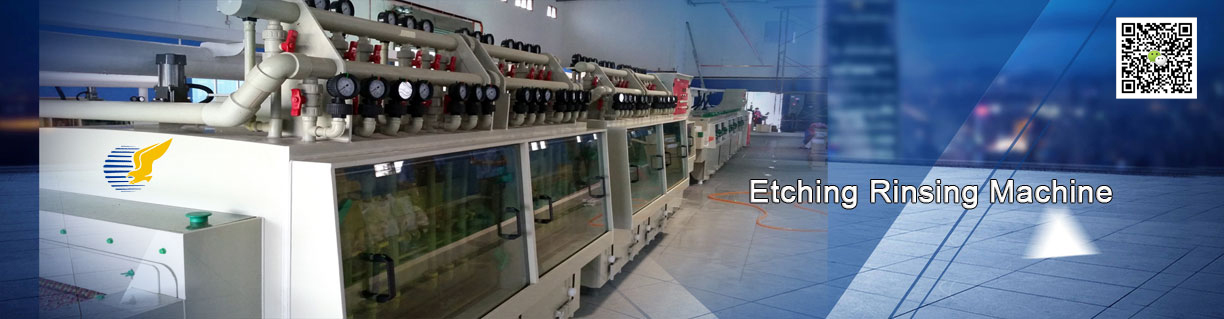
Modern etching machines like our GE-AE650 (alkaline) and GE-CL650 (acidic) share 80% of their components:
- Conveyor, drive system, and frame are identical
- Spray manifolds, nozzles, and oscillating headers are the same
- PLC control system and HMI are identical (different recipe files)
- Chamber material is the same: PP (polypropylene) or German-grade PVDF
- Heating system: titanium coils for both
The differences are:
- Exhaust treatment: alkaline needs water-scrubbed exhaust to capture NH₃ vapor; acidic needs alkaline-scrubbed exhaust to neutralize HCl vapor
- Pumps and seals: acidic uses higher-grade EPDM or Viton seals; alkaline uses standard EPDM
- Chemistry dosing system: alkaline uses ammonia dosing pump; acidic uses chlorine or NaClO₃ dosing with ORP sensor
Reconfiguring an etching line from alkaline to acidic (or vice versa) takes 4-6 hours: drain the chamber, flush with DI water, swap the dosing system, change the exhaust treatment, load the new chemistry, and run a calibration panel.
What About Ferric Chloride?
Ferric chloride (FeCl₃) is a third option, commonly used for prototype and small-batch PCB, and for metal etching (stainless steel, copper, brass). It is acidic chemistry with similar etch rate (25-50 µm/min) to acidic cupric chloride, but it cannot be regenerated as cleanly. Once the Fe³⁺ is reduced to Fe²⁺, the etchant loses activity and must be replaced.
Ferric chloride is the workhorse of prototype shops and metal etching. For high-volume PCB, acidic cupric chloride is more economical because of continuous regeneration. For very thin copper or temperature-sensitive substrates, ferric chloride at 25-30°C is gentler than alkaline or cupric chloride at 45-55°C.
Decision Framework: Which Chemistry for Your Line
- Identify your minimum line/space. If below 50µm, you need alkaline. Above 75µm, acidic is fine.
- Estimate annual production volume. Above 100,000 m², acidic wins on cost. Below 50,000 m², the cost difference is small.
- Check wastewater treatment capability. If you have biological treatment, alkaline is viable. If only chemical treatment, acidic is the easier option.
- Consider your operator skill level. Acidic regeneration is more forgiving. Alkaline chemistry is more sensitive to pH and ammonia loss.
- Run a trial etch on a sample panel. Before committing, etch a sample panel with both chemistries. Measure line width, sidewall angle, and undercut on your actual design. The visual difference is the most convincing evidence for production.
- Decide: single chemistry or both? If your design range is narrow, one chemistry is fine. If you serve both fine-line prototype and high-volume production, running both lines is the most flexible option.
Common Mistakes to Avoid
- Using acidic etching for fine-line PCB. The undercut will eat your fine traces. Don't try to push acidic below 50µm line/space.
- Skipping chemistry regeneration on acidic. Without continuous regeneration, the etchant loses activity within hours, etch rate drops, and quality becomes inconsistent. Regeneration is not optional for production.
- Not controlling pH on alkaline. Below pH 8.0, alkaline etch rate drops sharply and the solution can become unstable. Above pH 9.5, ammonia loss increases. Stay in the 8.5-9.5 window.
- Mixing chemistries in the same chamber. Even trace contamination of alkaline into acidic (or vice versa) can cause precipitation and inconsistent etching. Use separate chambers, or run a full DI water flush and recalibration between chemistries.
- Ignoring exhaust treatment. Both chemistries produce hazardous vapor. Alkaline ammonia exhaust must be water-scrubbed; acidic HCl exhaust must be alkaline-scrubbed. No exceptions.
Conclusion
Alkaline ammonia and acidic cupric chloride are complementary, not competing, chemistries. The right answer depends on your design rules, production volume, and waste handling capability. For a new PCB fab, a common pattern is to install both lines: alkaline for fine-line outer layers, acidic for inner layers and high-volume production. This gives you the flexibility to take on any customer design without compromise.
For more on etching chemistry, see our related articles: Ferric Chloride vs Cupric Chloride Etchant, Spray vs Immersion Etching Machine, and PCB Etching Process Step-by-Step.
Frequently Asked Questions
- What is the difference between alkaline and acidic PCB etching?
- Alkaline etching uses ammonia-based chemistry (pH 8.5-9.5) for fine-line work with low undercut. Acidic etching uses cupric chloride (pH 0-2) for high-volume production with continuous regeneration. The choice depends on your minimum line/space, production volume, and waste handling capability.
- Which is better for fine-line PCB?
- Alkaline ammonia is the standard for fine-line PCB. It produces straighter sidewalls and undercut below 10%, supporting line/space down to 25µm. Acidic etching undercuts 15-25%, limiting it to line/space above 50-75µm.
- Which is cheaper to operate?
- Acidic cupric chloride is cheaper in high-volume production because of continuous regeneration — operating cost can be 50-60% lower than alkaline. For low-volume or prototype work, the cost difference is small.
- Can the same etching machine run both chemistries?
- Yes, with caveats. The chamber, conveyors, and spray manifolds can be the same. The differences are construction materials, exhaust treatment, and chemistry dosing. Reconfiguring takes 4-6 hours.
- What is the typical etch rate?
- Alkaline ammonia: 15-25 µm/min at 45-50°C. Acidic cupric chloride: 50-80 µm/min at 45-55°C. Ferric chloride: 25-50 µm/min at 25-45°C.
- Which chemistry produces less waste?
- Acidic produces less waste in steady-state operation due to continuous regeneration. Alkaline produces more waste with high nitrogen content that needs biological treatment.