
Etching Machine Maintenance Guide: Daily, Weekly and Monthly Tasks
An etching machine is a long-life asset — a well-maintained conveyorised spray etcher will run for 10 to 15 years in a production environment. The difference between a line that runs that long and a line that fights downtime every month is the maintenance schedule. Most of the problems that operators blame on the machine are actually the result of a small task that was missed three months ago.
An etching machine is a long-life asset — a well-maintained conveyorised spray etcher will run for 10 to 15 years in a production environment. The difference between a line that runs that long and a line that fights downtime every month is the maintenance schedule. Most of the problems that operators blame on the machine are actually the result of a small task that was missed three months ago.
This guide is a practical maintenance schedule for a conveyor spray etching machine, plus a troubleshooting table for the issues that come up most often. Use it as a starting point and adapt it to your specific line, chemistry and production volume.
Quick Answer
- Daily tasks (5–10 minutes per shift): visual check, etchant level, temperature, conveyor running, fume hood draft, rinse water flow.
- Weekly tasks (30–60 minutes): spray pattern check, nozzle cleaning, pH / specific gravity check, conveyor roller inspection, rinse and dryer check.
- Monthly tasks (half-day): pump inspection, sump clean, heater descaling, hose and fitting inspection, calibration verification, regeneration system check.
- Annual tasks (1–2 days): full chamber inspection, lining check, frame and structural check, full electrical inspection, spare parts replacement.
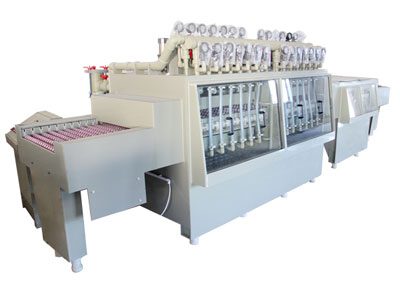
Why Maintenance Matters
An etching machine runs in a hot, oxidising acid environment 24 hours a day. That is harder on the equipment than almost any other process in a fab. Pumps see cavitation. Nozzles see scale. Heaters see coating. Hoses see chemical attack. Rollers see constant wet-dry cycles. None of these failures happens suddenly — they build up over weeks and months, and the visible symptom at the end is a panel of scrap.
The cost of a missed maintenance task is rarely the spare part. It is the lost production while the line is down, the chemistry that has to be dumped, the panels that come out under-etched or over-etched in the meantime, and the customer delivery that slips. A scheduled 30 minutes a week is the cheapest insurance the line will ever have.
Daily Tasks (Per Shift)
The daily walk-around is the highest-leverage maintenance activity on the line. Most catastrophic failures announce themselves in the 24 hours before they happen, and a 5-minute walk catches them.
- Etchant level in the sump: above the minimum, below the maximum. Top up with makeup chemistry as needed.
- Etchant temperature: within the working window. A drifting temperature is the first sign of a heater problem or a regeneration imbalance.
- Conveyor running smoothly: no unusual noise, no hesitation at start / stop, no slipping.
- Fume hood draft: a strip of paper held at the hood opening should be drawn gently inward. If it falls, the exhaust fan or scrubber needs attention.
- Rinse water flow: full and even on both top and bottom rinse bars. A drop in flow shows up as residue on the panel.
- Air knife dryer: confirm both faces are blowing clean, dry air at the right pressure.
- Spray pattern: a quick visual check of the chamber while running — even, full coverage, no dead stripes.
Weekly Tasks
Once a week, with the line stopped and safely vented, do the following:
- Spray pattern check. Hold a piece of cardboard under each nozzle bar for a few seconds with the pump running. The pattern should be even, with full coverage across the bar. Replace any nozzle that has a visibly distorted spray or is plugged.
- Nozzle cleaning. Soak plugged nozzles in a mild acid wash (compatible with the etchant), then back-flush with water. Do not use metal picks — they damage the nozzle orifice.
- Etchant specific gravity and pH. Record both. A drift in either is the first sign that regeneration is not keeping up. Most production lines have a target band — for ferric chloride, specific gravity around 1.36–1.46 and pH around 0.5–1.0 is typical.
- Conveyor roller inspection. Look for wear, flat spots, chemical attack. Rollers are usually the first wearing part on the line.
- Rinse bar and air knife. Check nozzles for plugging, check the air knife slot for damage or build-up.
- Log review. Look at the last week's readings of temperature, etch rate, pH, ORP. A small drift over several days is a maintenance problem waiting to happen.
Monthly Tasks
Once a month, with the line stopped for half a day if possible, do the following in addition to the weekly checks:
- Pump inspection. Check the pump casing for cracks, the mechanical seal for leaks, the motor for noise or overheating. Magnetic-drive pumps have no seal to wear, but the drive magnet can lose strength over time.
- Sump clean. Pump out the sump, rinse, and inspect the lining. Etching sludge accumulates in the sump and reduces the effective volume of working chemistry. A clean sump is a stable sump.
- Heater descaling. Heaters in ferric chloride and cupric chloride baths build up a scale layer that drops their efficiency by 20–40%. A monthly acid-compatible descaling (or whatever the manufacturer recommends) keeps them at full power.
- Hoses and fittings. Visual inspection of every hose, every clamp, every fitting. Acid attack on a hose shows up as a soft spot or a surface bloom before it becomes a leak.
- Calibration verification. Check the temperature probe, the level sensor, the ORP probe, the pH probe, and the conveyor speed readout against a reference. Probes drift; a reading that is 5 °C low is a 10% error in etch rate.
- Regeneration system check. Verify that the oxidant dosing pump is delivering the right volume, the makeup water valve is opening, and the controller is calling for chemistry at the expected rate.
Annual Tasks
Once a year, ideally during a planned maintenance window, do the following in addition to the monthly checks:
- Full chamber inspection. Look at the PP / PVC / PVDF lining. Check welds, look for cracks, check the structural frame for corrosion under the lining.
- Nozzle bar and manifold inspection. Check the manifold for internal corrosion, replace any nozzles that have drifted in spray angle or flow rate.
- Full electrical inspection. Tighten terminals, check insulation resistance on heaters and pumps, verify grounding, check the control panel for dust and moisture.
- Spare parts replacement. Replace wearing parts on schedule: pump seals, conveyor roller bearings, probe membranes, gaskets. The cost is small compared to an unplanned shutdown.
- Process audit. Run a standard test panel through the line and measure etch factor, line width, undercut. Compare to last year's audit. The trend is more useful than the absolute number.
Etching Machine Troubleshooting: 12 Common Problems
Most problems on an etching line show up as a panel defect first. Here is a practical troubleshooting table — symptom, most likely cause, what to do.
| Symptom | Most likely cause | Fix |
|---|---|---|
| Etch rate has dropped across the shift | Etchant exhausted, regeneration under-dosing | Check ORP / specific gravity; check oxidant dosing pump; top up with fresh chemistry |
| One side of panel over-etched | Blocked nozzle on the other side, or panel tilted | Clean nozzles; check conveyor supports; check entry / exit guides |
| Streaks on the panel | Dead nozzle, oscillation stopped | Replace nozzle; check oscillation drive |
| White residue on copper after etch | Insufficient rinse, dryer not working | Check rinse flow; check air knife pressure and angle |
| Etch factor dropping on fine traces | Etchant too hot or too concentrated | Lower temperature; check concentration; consider anti-undercut additive |
| Acid mist in the work area | Fume hood draft lost | Check fan, check duct for blockage, check scrubber |
| Conveyor slipping under load | Worn drive chain, tensioner loose | Tension chain; replace sprockets if worn |
| Panel warp after etch | Uneven rinse or dry, panel overheated | Check rinse balance; reduce etchant temperature; check dryer pressure |
| Pump losing flow | Cavitation, leak on suction side, scaled heater | Check sump level; check suction line for air; descale heater |
| Heater slow to reach temperature | Scale build-up on heater element | Descale heater; check concentration is not too high |
| Scratches on the panel | Debris on conveyor, worn rollers | Clean conveyor; replace damaged rollers |
| Unusual noise from chamber | Loose panel, foreign object, bearing failure | Stop the line, inspect, do not run with a known fault |
Most "machine" problems on an etching line are actually chemistry or process problems. Always check temperature, concentration and regeneration before you start taking the machine apart.
Need a Maintenance Plan for Your Line?
Send us the make and model of your etching machine, your chemistry, and your production hours. We will provide a tailored maintenance schedule and a recommended spare parts list.
Get a Maintenance PlanConclusion
A conveyor spray etching machine is a hard-working piece of equipment in a hostile environment. A simple, consistent maintenance schedule — daily walk-around, weekly clean, monthly inspection, annual overhaul — keeps the line at stable quality for the whole life of the equipment. Most catastrophic failures give a week's warning. The daily check is what catches them.


