
Small Etching Machine vs Industrial Etching Machine: How to Choose
The right size of etching machine is the single biggest decision after the chemistry. Buy too small and the line is a bottleneck from day one. Buy too large and the line sits idle while the chemistry and power bills pile up. Most etching shops either grew out of a small machine in 18 months or paid too much for an industrial line they only use at 30% capacity. Both are avoidable.
The right size of etching machine is the single biggest decision after the chemistry. Buy too small and the line is a bottleneck from day one. Buy too large and the line sits idle while the chemistry and power bills pile up. Most etching shops either grew out of a small machine in 18 months or paid too much for an industrial line they only use at 30% capacity. Both are avoidable.
This article walks through the actual difference between a small etching machine and an industrial etching machine, and the practical rule for choosing the right size for your shop.
Quick Answer
- Small etching machines are bench-top or floor-standing units for prototype, R&D, sample work and very small batch production. Cheap, flexible, low throughput.
- Industrial etching machines are conveyorised spray lines for medium to high volume PCB and metal etching production. Higher throughput, better etch quality, higher capital and operating cost.
- Choose small for prototype, R&D, schools, training labs, sample work and very small batch custom jobs.
- Choose industrial for any serious production volume, large panels, tight tolerances, or jobs that need a stable, repeatable process every day.
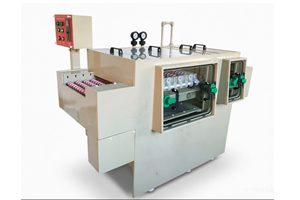
What a Small Etching Machine Is
A small etching machine is a compact, low-throughput unit designed for sample work, prototype runs and very small batch production. The most common forms are:
- Bench-top immersion tanks. A heated, agitated tank of etchant. The part is held on a small rack and lowered in. Capacity is one part at a time, etch times are slow, etch factor is limited.
- Bench-top spray units. A small spray chamber with a hand-loaded rack. Better etch factor than immersion, but the operator loads and unloads every part.
- Compact conveyor lines. A short conveyor (often 300–500 mm wide) running at modest speed. Still hand-fed at the entry, still hand-unloaded at the exit, but with continuous spray and better uniformity than a tank.
A small etching machine typically costs in the low thousands to low tens of thousands USD, fits on a bench or in a corner of a workshop, and runs from a single-phase electrical supply. The chemistry consumption is small, the maintenance is minimal, and the operator can stop and start the line at will. For sample work and very small batches, this is exactly the right tool.
What an Industrial Etching Machine Is
An industrial etching machine is a full conveyorised spray etching line designed for sustained production. Typical specifications:
- Conveyor width 600 mm to 1100 mm, sometimes wider.
- Conveyor speed 0.5 to 6 m/min, with PLC-controlled recipe storage.
- Top and bottom oscillating spray bars with full-coverage nozzles.
- Inline regeneration system with oxidant dosing and ORP / specific gravity control.
- Matched fume hood and packed-tower scrubber.
- Three-phase electrical supply, compressed air, water, drain.
An industrial etching machine typically costs from the tens of thousands to the low hundreds of thousands USD depending on size and specification. It occupies a dedicated area of the factory, often with its own ventilation, and runs for one to three shifts a day. The output is in square metres of panel per shift, not panels per day.
Side-by-Side Comparison
| Factor | Small etching machine | Industrial etching machine |
|---|---|---|
| Typical width | ≤ 500 mm | 600–1100 mm+ |
| Throughput | A few parts to a few m²/day | 20–250 m²/shift |
| Loading | Hand-loaded, batch | Conveyor, continuous |
| Etch quality | Good (spray) to limited (immersion) | Excellent, repeatable |
| Chemistry use | Low absolute, high per m² | Higher absolute, low per m² (with regeneration) |
| Operator time | High (load / unload every part) | Low (one operator per line) |
| Capital cost | Low | Medium to high |
| Footprint | Bench or corner | Dedicated factory area |
| Best fit | Prototype, R&D, very small batch | Production, large panels, tight tolerances |
Where a Small Etching Machine Wins
A small etching machine is the right tool when the volume is low and the variety is high. It is also the right tool when the work is genuinely experimental — when the etchant, the temperature and the artwork are all changing from run to run.
- Prototype and R&D shops. Process development, sample making, technology trials. The flexibility of a small machine, and the ability to swap chemistries quickly, matters more than throughput.
- Schools and training labs. Teaching the principles of photochemical etching. A small machine is safe, visible, and forgiving.
- Job shops doing custom one-off work. A handful of panels a day, each different. The industrial line is overkill; the small line is exactly the right scale.
- Start-up etching shops. Most new etching businesses start with a small machine to prove the market, then scale up. A small machine lets you start without a huge capital commitment.
- Backup capacity in a production fab. For overflow, for samples, for the awkward job that the conveyor line cannot run.
Where an Industrial Etching Machine Wins
The industrial line wins when the volume is real, the variety is low, and the quality bar is high. Three shifts a day, panels that look the same, the same chemistry, the same conveyor speed. That is the industrial line's home turf.
- Production PCB fabs. Single-sided, double-sided, multilayer, aluminium PCB. The volume and the tolerance are both industrial from the start.
- Metal nameplate, signage, plaque and decorative panel production. Hundreds or thousands of panels a week, often in long runs of the same part.
- Photochemical etching of thin metal parts at scale. Filters, springs, lead frames, RF shields, encoder discs — any of these in volume is an industrial line's job.
- Chemical milling of large aerospace parts. Long etch times in aggressive chemistry need a controlled, instrumented line.
- High-volume flexible cutting die and hot foil stamping die production. Same part, hundreds of times, tight tolerance on the cutting edge.
The Hidden Costs of Getting It Wrong
The two common mistakes are very different, and both are expensive.
Buying too small and growing out of it
A small machine in a growing shop becomes the bottleneck. Every job has to wait for the operator to load the next part. The line is "full" at 20 m² a week while the rest of the factory could be running 200 m². Six to 18 months in, the choice is to buy a second small machine (which doubles the operator cost) or to replace the small machine with an industrial one (which writes off the small machine's value). Neither is great.
Buying too large and under-using it
An industrial line sitting at 30% capacity is paying for the depreciation, the floor space, the maintenance and the chemistry of a line that is doing a third of the work it was sized for. The chemistry still has to be made up and dumped on a schedule, the heaters still cycle, the operators still need to be on shift. The unit cost of every panel is much higher than the brochure implied.
Rule of thumb: if your expected volume is more than 30 m²/week of panel, an industrial line is usually the right starting point. Below that, start with a small line and plan the upgrade.
The Decision Rule
- Estimate the volume. Square metres of panel per week, in your worst-case month, not your best.
- Estimate the variety. How many different parts? If the answer is dozens, lean small. If the answer is a handful of parts repeated thousands of times, lean industrial.
- Estimate the tolerance. Etch factor, line width, registration. Tight tolerances on large panels are an industrial line's job.
- Match the size to the answer. Most shops that think they need a small machine actually need an industrial one, and vice versa. The number usually lands closer to industrial than the buyer expected.
When in doubt, it is usually cheaper to buy one size larger than one size smaller. A small machine can be sold for a reasonable fraction of its price; an under-used industrial line ties up capital for a decade.
Not Sure Which Size Fits Your Job?
Send us your largest panel, your average panel, your monthly volume and the variety of parts. We will recommend the right size of small, mid, or industrial etching line.
Get a Sizing RecommendationConclusion
The size of the etching machine should follow the work, not the budget. A small etching machine is a great tool for prototype, R&D, training and very small batch work. An industrial etching machine is the right tool for production, large panels, and tight tolerances. Most shops need an industrial line sooner than they think. A few genuinely do not. The rule is the volume, not the brochure.