Etching Machine vs Stamping: How to Choose for Your Part
Two processes dominate flat metal part manufacturing: chemical etching and metal stamping. They look like competitors but they are actually complementary — each one wins for a different part geometry, volume, and lead time. The wrong choice costs you 2–5× the part price, and the right choice is usually obvious once you look at the part.
Two processes dominate flat metal part manufacturing: chemical etching and metal stamping. They look like competitors but they are actually complementary — each one wins for a different part geometry, volume, and lead time. The wrong choice costs you 2–5× the part price, and the right choice is usually obvious once you look at the part.
This guide compares the two processes side by side, lays out the part geometries that each one does best, and gives a simple decision rule for picking the right one.
Quick Answer
- Etching is the right process for: complex 2D outlines, very fine features, thin foil, hard-to-work metals, prototype / low-volume production, and parts that must be burr-free and stress-free.
- Stamping is the right process for: simple 2D outlines, deep forming or bending, high-volume production of simple parts, and parts that need tight thickness control.
- The two are complementary: many production lines use both, with etching for the fine details and stamping for the deep forms.

Etching at a Glance
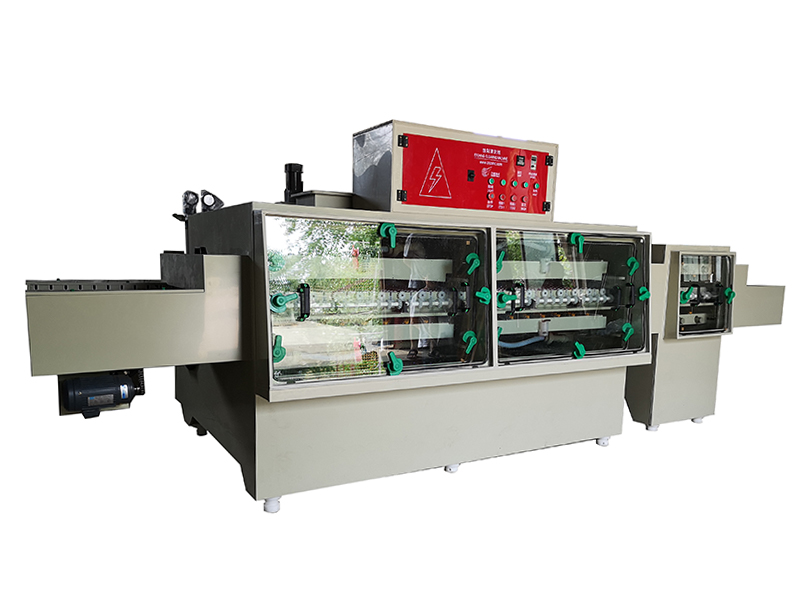
Chemical etching uses a photoresist to mask the parts of the metal sheet that should remain. The sheet is sprayed with etchant, the exposed metal dissolves, and the finished part falls out of the sheet. The whole process is chemical, not mechanical.
The three things that make etching different from any mechanical process:
- No hard tooling. A phototool is the only "tool" required. New artwork = new phototool = new part. Tooling cost is in the hundreds of dollars, not the thousands.
- No mechanical force on the part. The metal is dissolved, not cut or stamped. There is no burr, no stress, no work-hardening, and no spring-back.
- Complex 2D geometry for free. A spiral, a logo, a 50 µm slot, a hexagon grid, a complex outline — all etch at the same cost as a circle.
Stamping at a Glance
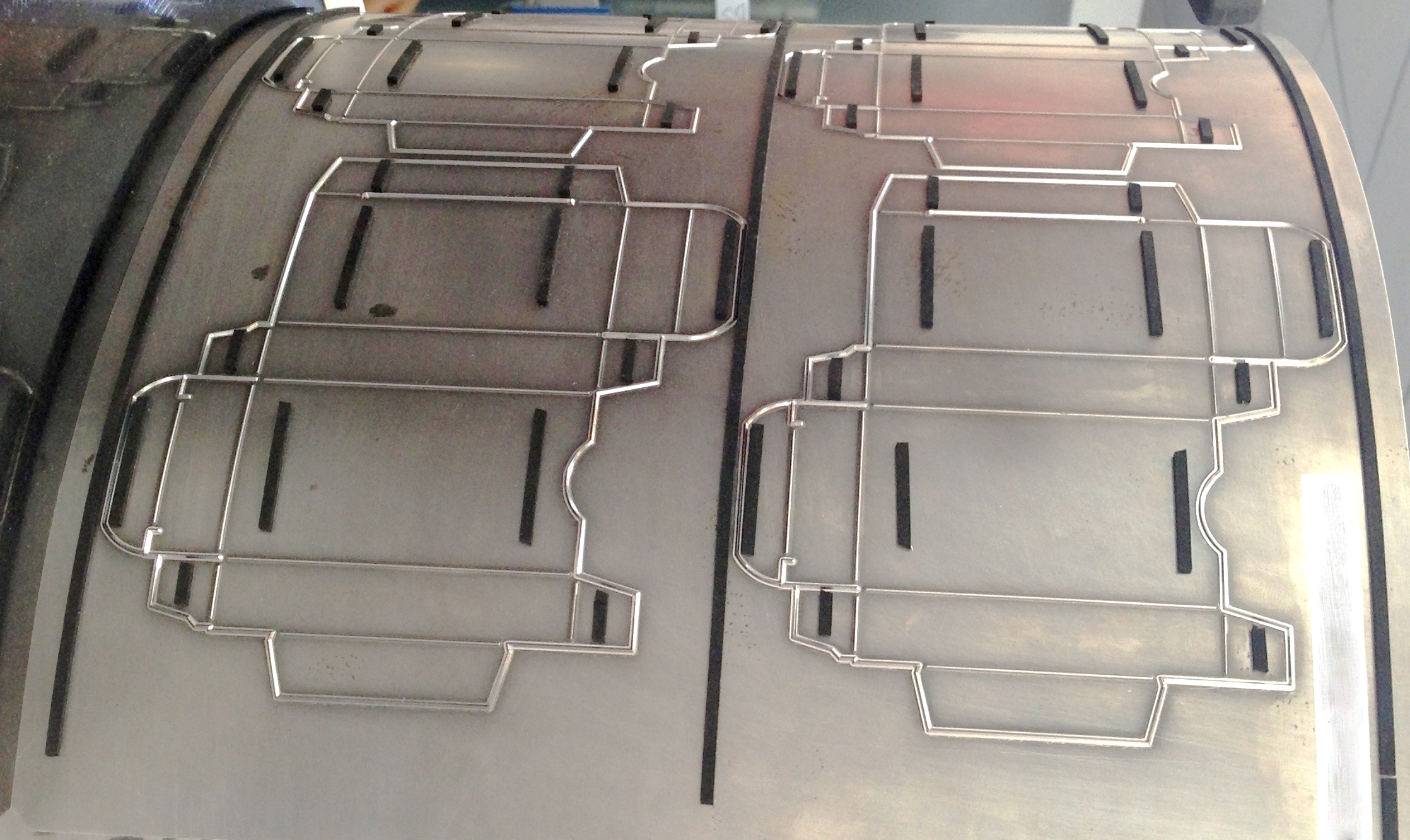
Metal stamping uses a press and a hardened die to cut, form or bend metal sheet. The die has the negative of the part. The press pushes the die into the metal at high force, and the part is sheared out of the sheet.
The three things that make stamping different from any chemical process:
- Hard tooling is required per part. Each part geometry needs a die cut from hardened tool steel. Die cost starts at a few thousand dollars and goes up to tens of thousands for complex parts.
- Very high unit speed. A modern stamping press runs 30–2000 strokes per minute. Once the die is built, the unit cost drops fast with volume.
- Deep forms and bends are possible. Stamping can bend, draw, emboss, coin, and form 3D features. Etching cannot.
Side-by-Side Comparison
| Factor | Chemical etching | Metal stamping |
|---|---|---|
| Tooling cost | $100–$1,000 (phototool) | $2,000–$50,000 (hardened die) |
| Lead time (tool to part) | 1–3 days | 2–8 weeks |
| Unit cost at low volume (10–1000 parts) | Low | High (diluted by tooling) |
| Unit cost at high volume (100,000+ parts) | Flat — chemistry cost dominates | Very low — presses are fast |
| Min. feature size | 0.05–0.1 mm (foil dependent) | 0.3–0.5 mm (die dependent) |
| Min. hole / slot | 0.1× foil thickness | 0.5× foil thickness |
| Surface burr | None | Yes — deburr required |
| Internal stress | None | Yes — work hardening |
| Hardness change | No | Often — especially at the cut edge |
| Forming / bending | No | Yes |
| Best material thickness | 0.02–1.5 mm | 0.2–6.0 mm |
| Hard materials (SS, Ti, hardened spring steel) | Easy — chemistry does the work | Hard — tooling wears fast |
When Etching Wins
Etching is the right process when any of the following applies:
- Complex 2D geometry. Logos, fine mesh patterns, spiral inductors, precision filter slots, decorative panels with many small features.
- Thin foil (under 0.2 mm). Etching handles 0.05 mm foil easily. Stamping needs careful fixturing, and the part can tear or distort.
- Hard-to-work metals. Stainless steel, titanium, beryllium copper, hardened spring steel — etching does not care about hardness, only chemistry.
- Burr-free or stress-free parts. Etched parts have no burr, no work hardening, no spring-back. Important for medical, aerospace, and electronics applications.
- Low to medium volume. From a single prototype to 100,000 parts, etching is usually cheaper than stamping. Above 100,000 parts, stamping starts to win on unit cost.
- Short lead time. New artwork in 1–3 days. Stamping needs 2–8 weeks for die build.
When Stamping Wins
Stamping is the right process when any of the following applies:
- Very simple 2D outline. Circle, rectangle, hexagon — no fine features. Stamping is fast and accurate.
- Deep forming or bending required. Stamping can draw, bend, emboss, coin. Etching cannot.
- Very high volume. 100,000+ parts and a stable design. The die cost is amortised over a large volume, and the unit cost drops dramatically.
- Thicker sheet. 1.5–6 mm sheet etches slowly and under-etches badly. Stamping handles thicker sheet easily.
- Tight thickness tolerance on the part itself. Stamping can hold ±5 µm thickness on a 0.5 mm part. Etching cannot, because the etching is uniform and the original sheet thickness tolerance is the limit.
The Hybrid: Stamped and Etched Together
For complex parts that need both forming and fine detail, many production lines use both processes in sequence. The typical pattern:
- Stamp first, etch second. The deep form (a bent bracket, a drawn cup, a coined boss) is stamped, and the fine detail (a logo, a serial number, a slot pattern) is etched into the formed part.
- Etch first, stamp second. The flat sheet is etched with the fine detail, then the etched flat is stamped into a formed part. The etched features survive stamping with little distortion.
The combination gives the best of both processes, and is the standard for high-end consumer electronics, automotive trim, and aerospace structural parts.
A Simple Decision Rule
When choosing between etching and stamping for a new part, work through this checklist:
- Is the part flat, or does it need forming? If flat, either process works. If formed, stamping is required (or the part is formed after etching).
- What is the thinnest feature? Below 0.3 mm: etching. Above 0.5 mm: either.
- What is the production volume? Below 100,000: etching is usually cheaper. Above 1,000,000: stamping is usually cheaper. In between, model both and compare.
- What is the material? Hard, thin, or exotic: etching. Soft, thick, common: either.
- What is the lead time? Under 1 week: etching. Over 1 month: either.
- Does the part need to be burr-free or stress-free? Yes: etching. No: either.
If most answers point to etching, etch. If most point to stamping, stamp. If mixed, model both and compare total cost.
Choosing Between Etching and Stamping?
Send us your part drawing, your material, your volume target and your lead time. Golden Eagle will quote both an etching line and a stamping line for the same part and let you see the cost difference.
Get a ComparisonConclusion
Etching and stamping are complementary processes. Etching wins on complex 2D geometry, fine features, thin foil, hard metals, low-to-medium volume, and short lead time. Stamping wins on simple 2D geometry, deep forming, very high volume, thicker sheet, and tight thickness tolerance. Many production lines use both. The right choice depends on the part, the volume and the lead time — there is no single right answer.