
Titanium Etching: Process, Challenges & Applications
Titanium etching is the chemical removal of titanium to create thin, precise parts — from the support plates inside foldable smartphones to surgical components and aerospace shims. Titanium is prized for its high strength-to-weight ratio, corrosion resistance, and biocompatibility, but those same qualities make it one of the hardest metals to etch cleanly. This guide explains why titanium is difficult to etch, which etchants are used, how the photochemical etching process is adapted for it, and where etched titanium parts are used.
Titanium etching is the chemical removal of titanium to create thin, precise parts — from the support plates inside foldable smartphones to surgical components and aerospace shims. Titanium is prized for its high strength-to-weight ratio, corrosion resistance, and biocompatibility, but those same qualities make it one of the hardest metals to etch cleanly. This guide explains why titanium is difficult to etch, which etchants are used, how the photochemical etching process is adapted for it, and where etched titanium parts are used.
Quick Answer
- Yes, titanium can be chemically etched, but it requires a hydrofluoric-acid-based etchant because titanium's natural oxide layer resists ordinary acids.
- It is etched with the same photochemical (PCM) process used for other metals, with chemistry and equipment adapted for titanium.
- Etched titanium is used in foldable phones, medical implants, aerospace, and fine filters/meshes.
- The process produces burr-free, stress-free parts and is ideal for thin titanium foil and sheet.
What Is Titanium Etching?
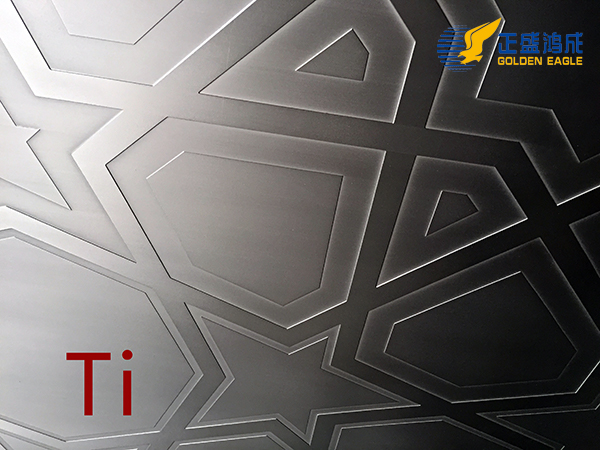
Titanium etching uses a patterned, acid-resistant mask and a chemical etchant to dissolve titanium only where it is exposed, leaving a precise part. It is a specialized branch of metal etching technology: the same photolithography-plus-chemistry approach used on stainless steel and copper, but with an etchant strong enough to break through titanium's protective oxide. Because the metal is dissolved rather than cut or punched, the finished part is perfectly flat, free of burrs, and free of the mechanical stress that stamping or machining would introduce.
Why Is Titanium Difficult to Etch?
The challenge with titanium comes down to chemistry. The moment titanium is exposed to air, it forms an extremely stable, self-healing layer of titanium dioxide (TiO2) on its surface. This passive oxide film is what gives titanium its outstanding corrosion resistance — and it also shrugs off the ferric chloride and cupric chloride etchants that work well on stainless steel and copper.
To etch titanium, the etchant must be able to attack and keep dissolving that oxide layer. In practice this means hydrofluoric-acid (HF) based chemistry. Titanium also tends to absorb hydrogen during etching, which can make the metal brittle if the process is not properly controlled, and it reacts exothermically, so temperature must be managed carefully. These factors make titanium etching a job for specialized chemistry and equipment rather than a standard etching line.
What Etchant Is Used for Titanium?
Titanium is etched almost exclusively with hydrofluoric-acid-based etchants. HF is usually combined with an oxidizing acid such as nitric acid (HNO3) to control the reaction rate, reduce hydrogen pick-up, and give a smoother etched surface. The exact blend, concentration, and temperature are tuned to the titanium grade and the required etch depth and finish.
Safety note: Hydrofluoric acid is extremely hazardous — it causes severe burns and is dangerous even in dilute form. Titanium etching must only be carried out by trained operators using corrosion-resistant, fully ventilated equipment, with appropriate protective equipment and emergency procedures in place. Spent etchant must be neutralized and treated in line with environmental regulations.
The Titanium Etching Process Step by Step
Titanium follows the same photochemical sequence as other metals, adapted for its chemistry:
- Cleaning. The titanium sheet is degreased and cleaned so the photoresist adheres uniformly.
- Photoresist coating. A light-sensitive resist is laminated or coated onto both sides of the sheet.
- UV exposure. The part image on a phototool is exposed onto the resist under UV light, in tight registration on double-sided parts.
- Developing. The unhardened resist is washed away to expose the titanium that will be etched.
- Etching. The sheet is sprayed with a heated HF-based etchant that dissolves the exposed titanium, with temperature and spray pressure tightly controlled.
- Stripping & inspection. The remaining resist is removed, and parts are rinsed, dried, and inspected for accuracy and edge quality.
The principle is identical to the general chemical etching process — the difference is entirely in the etchant chemistry and the corrosion resistance of the equipment that has to handle it.

How Thin Can Etched Titanium Parts Be?
Like other photochemically etched metals, titanium etching is a thin-gauge process. It is well suited to titanium foil and sheet from roughly 0.02 mm to 1 mm thick, with achievable tolerances scaling with thickness — generally around ±10% of the material thickness. This makes it ideal for the very thin, intricate parts, such as foldable-phone support sheets and fine meshes, that would be impossible to stamp or machine without distortion.
Applications of Etched Titanium
- Foldable smartphones & consumer electronics — thin titanium support plates and hinge components that combine strength with light weight.
- Medical devices — biocompatible surgical parts, implant components, and fine instruments that benefit from titanium's compatibility with the human body.
- Aerospace — lightweight shims, brackets, and gaskets where strength-to-weight ratio is critical.
- Filtration & mesh — corrosion-resistant titanium filter meshes and screens for harsh chemical and marine environments.
- Heat exchangers & fuel cells — thin etched titanium plates for energy and process applications.
Titanium Etching vs Laser and Stamping
| Factor | Titanium Etching | Laser Cutting | Stamping |
|---|---|---|---|
| Edge quality | Burr-free, no heat-affected zone | Heat-affected, possible discoloration | Burrs, work hardening |
| Stress on part | None — stays flat | Thermal stress | Mechanical stress |
| Tooling cost | Low (photo film) | None | Very high (hard die) |
| Best for thin foil | Excellent | Can distort very thin foil | Distorts thin foil |
| Complex patterns | No extra cost | Slower per part | Raises tooling cost |
For a broader comparison of chemical and beam-based methods, see our article on etching vs laser engraving.
Equipment for Titanium Etching
Because HF-based etchants are so aggressive, titanium etching demands equipment built from corrosion-resistant materials with sealed fume handling and accurate temperature and spray control. A dedicated titanium etching machine is engineered for exactly this, while the right etching chemicals keep the process stable and the finish consistent. Golden Eagle has supplied etching equipment to precision manufacturers since 2003, including lines configured for titanium and other reactive metals.
Need to Etch Titanium Parts?
Tell us your titanium grade, thickness, and part design — Golden Eagle will recommend the right etching machine and chemistry for safe, repeatable results.
Talk to an EngineerConclusion
Titanium can be etched into thin, intricate, burr-free parts — but only with hydrofluoric-acid-based chemistry strong enough to overcome its protective oxide layer, and only with equipment and operators equipped to handle that chemistry safely. When done correctly, titanium etching unlocks parts that are impossible to make any other way, which is why it has become essential to foldable phones, medical devices, aerospace, and advanced filtration. Match the titanium grade and thickness to the right etching equipment and chemistry, and the process delivers precise, stress-free results.