
Etching Wastewater Treatment: A Complete Compliance Guide
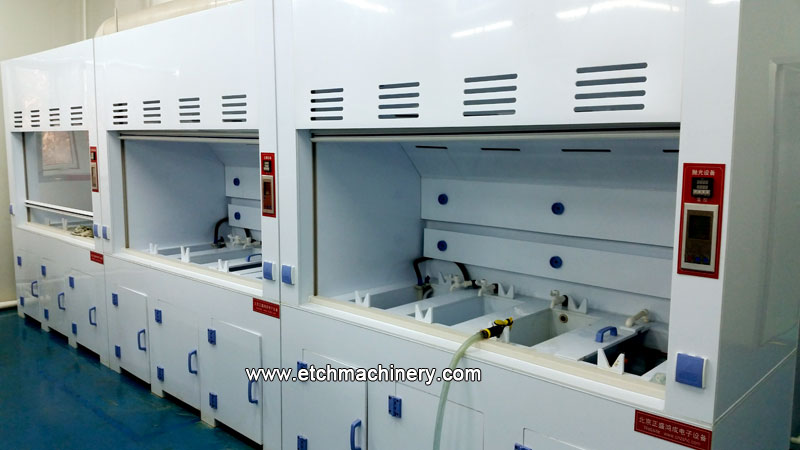
Spent etching etchant contains dissolved heavy metals (copper 30-150 g/L, iron 50-200 g/L, nickel 10-80 g/L), residual acid or alkali, and other process chemicals. Untreated discharge of this wastewater is illegal in virtually every jurisdiction and causes severe environmental harm — copper is toxic to aquatic life at concentrations as low as 0.5 ppm. Compliance is not optional.
The Standard Treatment Train (5 Stages)
Stage 1: pH Adjustment (Neutralization)
Add sodium hydroxide (NaOH) to raise pH from 1-2 (acidic) to 8.5-9.5 (slightly alkaline). This converts dissolved metal ions to insoluble hydroxide precipitates:
- Cu²⁺ + 2OH⁻ → Cu(OH)₂ ↓ (blue precipitate)
- Fe³⁺ + 3OH⁻ → Fe(OH)₃ ↓ (brown precipitate)
- Ni²⁺ + 2OH⁻ → Ni(OH)₂ ↓ (green precipitate)
For alkaline ammonia etchant, the pH adjustment is the opposite — add sulfuric acid (H2SO4) to lower pH to 8.5-9.5, which retains copper in solution and requires separate ion exchange.
Stage 2: Coagulation and Flocculation
Add polyaluminum chloride (PAC, 50-200 ppm) as coagulant, then anionic polyacrylamide (PAM, 1-5 ppm) as flocculant. This binds the fine hydroxide precipitate particles into larger, faster-settling flocs. Typical residence time: 20-30 minutes in a slow-stir tank.
Stage 3: Clarification (Solid-Liquid Separation)
Use one of:
- Lamella clarifier: Inclined plate settler, compact footprint, 80-90% solids removal efficiency. Best for medium-to-large flow rates.
- Conventional settling tank: 4-8 hour retention. Lower cost but larger footprint. Suitable for small flow rates.
- Dissolved air flotation (DAF): Floats sludge to surface for skimming. Best for oily or low-density sludge.
Stage 4: Sludge Dewatering
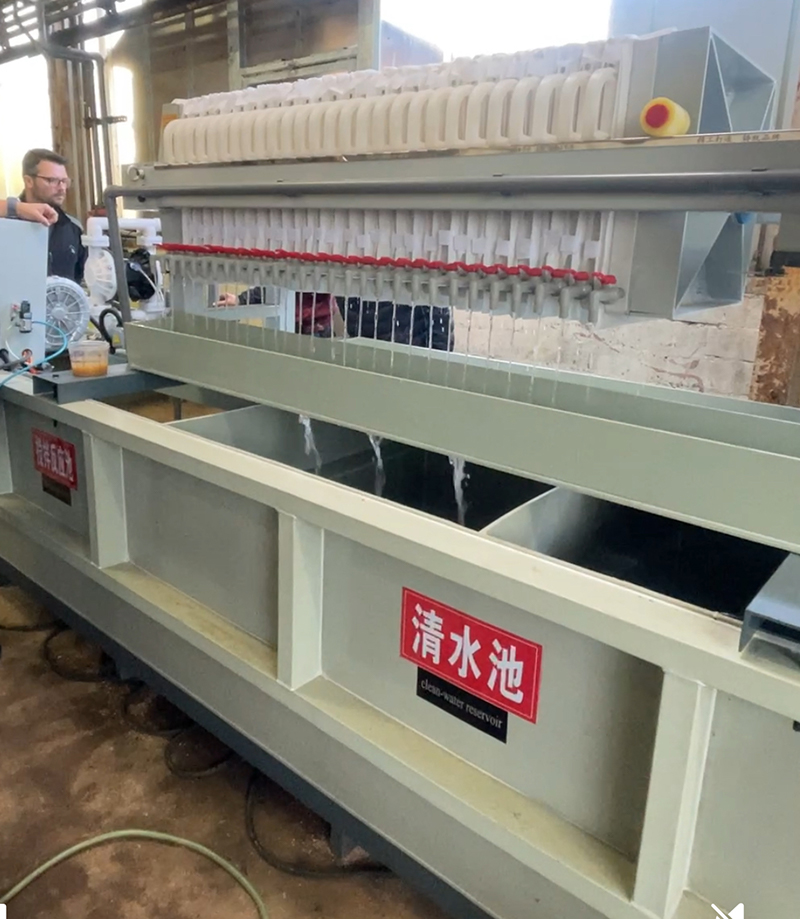
The settled metal hydroxide sludge (typically 2-5% solids) is dewatered to 25-35% solids using a filter press. The dewatered cake is sent to a metal refinery for copper/nickel recovery — this often generates a small revenue stream ($200-500 per ton of dry cake for copper-rich sludge).
Stage 5: Polishing (Ion Exchange or Membrane)
The clarified water from Stage 3 typically still contains 1-10 ppm residual heavy metals. To meet strict discharge standards (<0.5 ppm Cu, <1 ppm total heavy metals), pass through:
- Ion exchange resin (chelating): removes Cu, Ni, Zn down to <0.1 ppm. Resin regenerated with acid. Most common for small-medium systems.
- Reverse osmosis (RO): removes 95-99% of all dissolved solids. Treated water can be recycled back to the etching line as rinse water — closes the water loop. Higher capital cost.
Compliance: Effluent Limits by Region
| Parameter | EU (2008/105/EC) | US EPA (40 CFR 433) | China (GB 21900-2008) |
|---|---|---|---|
| pH | 6-9 | 6-9 | 6-9 |
| Total Cu (mg/L) | ≤ 0.5 | ≤ 2.07 (daily max) | ≤ 0.5 |
| Total Ni (mg/L) | ≤ 0.5 | ≤ 2.38 | ≤ 0.5 |
| Total Cr (mg/L) | ≤ 0.5 | ≤ 2.77 | ≤ 0.5 |
| Total Fe (mg/L) | ≤ 2.0 | — | ≤ 3.0 |
| COD (mg/L) | ≤ 125 | — | ≤ 100 |
| SS (mg/L) | ≤ 35 | ≤ 52 | ≤ 50 |
Cost of Wastewater Treatment
For a mid-size etching line (1-5 m³/hr wastewater):
- Equipment capital cost: $9,800-$80,000 depending on flow rate and target effluent quality
- Chemicals (NaOH, PAC, PAM, ion exchange regenerant): $2-$5 per m³ of wastewater
- Sludge disposal (if no metal recovery): $100-$300 per ton of dry cake
- Energy: $0.5-$2 per m³ (pumps, mixers, RO)
Tip: Copper recovery from sludge via electrowinning can offset $1-3 per m³ of treatment cost — turning an environmental cost into a small revenue stream.
Choosing a Treatment System
When buying an etching line, ask the manufacturer to supply a matched wastewater treatment skid. Golden Eagle etching lines come with engineering specifications for the required treatment capacity, and we can supply a turnkey treatment skid sized to match the etching line. This avoids the most common installation mistake: undersized wastewater treatment that bottlenecks the entire production line.
Get Expert Help Choosing the Right Etching Equipment
Tell us your material, throughput, and feature size requirement. Our engineering team responds with a tailored recommendation and price within 24 hours — no obligation.
Request Quotation