

How to Choose a PCB Etching Machine: 7 Key Specifications
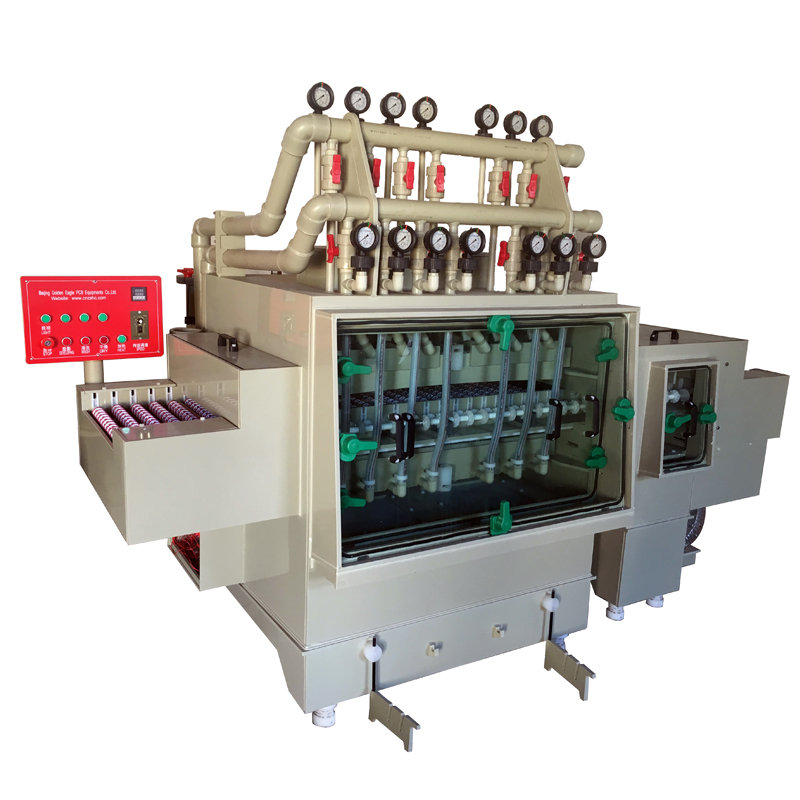
When comparing PCB etching machine quotations, these 7 specifications will determine 90% of your production outcome. Ignore vague marketing claims and compare these numbers directly across vendors.
The 7 Specifications That Actually Matter
1. Working Width (Panel Size Capacity)
The maximum PCB panel width the conveyor can accept. Common sizes: 400 mm (lab/R&D), 650 mm (standard industrial), 1300 mm (large panel), 2500 mm (architectural). Choose ≥ your largest panel size + 50 mm clearance. Going larger than you need adds 30-50% to the price; going smaller forces you to pre-cut panels.
2. Conveyor Speed (m/min)
How fast the panel moves through the etch chamber. Standard range: 0-6 m/min, infinitely variable. Higher speed = higher throughput, but etch time drops — so for thick copper (≥35 μm) you may need slower speed. A 1.5-2.5 m/min range covers 90% of PCB applications.
3. Etch Rate (μm/min)
Material removal rate, typically 25-50 μm/min for FeCl3 on copper at 25°C, or 30-60 μm/min for CuCl2. Doubles for every 10°C increase up to ~50°C. Look for machines with temperature control (heater + chiller) — this is what separates precision etching from inconsistent etching.
4. Chemistry Compatibility
Confirm the machine supports the etchant you plan to use:
- FeCl3 (ferric chloride): general purpose, economical, low capital cost. Best for prototype and small batch.
- CuCl2 (cupric chloride): regenerable, 30-50% faster, lower chemical cost at scale. Requires etchant regeneration system.
- Alkaline ammonia: best for HDI fine-line (≤50 μm). Higher equipment cost but essential for HDI PCB.
- Acidic peroxide sulfate: for thin copper / flex PCB where FeCl3 leaves residue.
5. Precision / Minimum Line Width
Standard precision: ±0.02 mm to ±0.05 mm. HDI-grade: ±0.01 mm with 25 μm minimum feature. If you're etching ≥100 μm features (most industrial PCB), standard precision is fine. For HDI / flex PCB / lead frame, demand fine-line capability with documented test results.
6. Throughput (Panels/Hour)
Calculated as: panels/hour = (conveyor speed m/min × 60) / panel length m × number of active chambers. A standard 650 mm single-chamber line at 2 m/min with 600mm panels = ~200 panels/hour. Dual-lane configurations can reach 500+ panels/hour.
7. After-Sales: Warranty, Spare Parts, Documentation
The hidden cost of cheap machines is downtime. Demand:
- Minimum 12-month warranty with clear coverage scope
- 10-year spare parts supply commitment in writing
- Full English operation manual + electrical schematic + P&ID
- CE Technical File and Declaration of Conformity
- Remote commissioning support via video call
- On-site engineer option with clear pricing (typically $3,000-$8,000 per engineer + travel)
Free Specification Comparison Checklist (Printable)
Use this 7-point checklist when comparing vendor quotations. Request numerical answers, not marketing language.
| Spec | Your Requirement | Vendor A | Vendor B |
|---|---|---|---|
| Working width | ___ mm | ___ | ___ |
| Conveyor speed | ___ m/min | ___ | ___ |
| Etch rate (Cu, 25°C) | ___ μm/min | ___ | ___ |
| Chemistry support | FeCl3 / CuCl2 / Alkaline | ___ | ___ |
| Precision (± mm) | ___ | ___ | ___ |
| Throughput | ___ panels/hr | ___ | ___ |
| Warranty (months) | ≥12 | ___ | ___ |
| CE certified | Yes | ___ | ___ |
If you want help filling this in for your application, see our etching equipment comparison page or request a quotation with these 5 inputs: substrate, panel size, throughput, feature size, target delivery date.
Get Expert Help Choosing the Right Etching Equipment
Tell us your material, throughput, and feature size requirement. Our engineering team responds with a tailored recommendation and price within 24 hours — no obligation.
Request Quotation