
Double-Sided PCB Etching Machine: Process, Alignment and Quality Control
Most PCBs are double-sided: copper traces on the front of the board and a different set of traces on the back, connected by plated through-holes. That symmetry is what makes the double-sided PCB etching machine different from a single-sided line. Both faces of the panel have to be etched at the same time, to the same depth, with the same line width — and the patterns on the front and back have to line up to the holes within a fraction of a millimetre.
Most PCBs are double-sided: copper traces on the front of the board and a different set of traces on the back, connected by plated through-holes. That symmetry is what makes the double-sided PCB etching machine different from a single-sided line. Both faces of the panel have to be etched at the same time, to the same depth, with the same line width — and the patterns on the front and back have to line up to the holes within a fraction of a millimetre.
This article explains how a double-sided PCB etching machine actually works, where the alignment comes from, what defects the process is most prone to, and the machine features that decide whether the line runs at 95% yield or 70% yield.
Quick Answer
- Double-sided PCB etching etches copper from both faces of a panel in a single pass, with the top and bottom patterns in exact registration to each other and to the drilled holes.
- Alignment is set upstream — the artwork has to be pre-registered to the drill program and the lamination has to be stable. The etching machine preserves that alignment; it does not create it.
- Key machine features for double-sided work: top and bottom spray, conveyor that holds the panel flat, controlled entry / exit, and a rinse and dry section that does not warp the panel.
- Most common defects are over-etch, undercut, and mis-registration between layers — all driven by process drift in the etching machine.
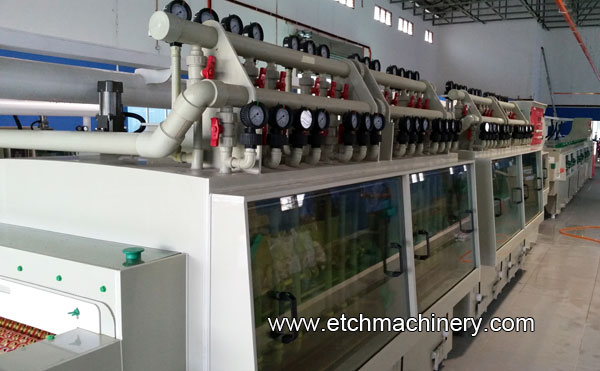
Why Double-Sided PCB Etching Is Different
On a single-sided board, one face is fully copper-clad, the other is bare substrate with no copper to remove. The etching machine only has to spray one face, and the etch quality on the back is irrelevant. A double-sided PCB is different: both faces are copper-clad, both faces carry a pattern, and both faces have to survive the etch at the same time with the same line width and the same etch depth.
That single change cascades through the line. The etching machine needs spray on both sides. The conveyor needs to hold the panel flat through the chamber — a warped panel is etched unevenly on the two sides. The rinse and dry sections need to be designed so the wet panel does not twist, because the moment it twists, the through-hole alignment is gone. The chemistry control has to be tighter, because a small over-etch on the back side shows up as a much bigger dimensional change than on the front.
Where the Alignment Comes From
The etching machine does not align the front and back patterns. The alignment is set in three earlier steps: drilling, imaging and lamination. Understanding where alignment actually comes from makes it obvious what the etching machine has to do — and what it has to avoid doing.
Step 1: Drilling
The drill program hits the panel from above with a defined X-Y origin. The position of every through-hole is locked to that origin. If the panel is moved after drilling, the origin shifts. A double-sided etching machine has to accept the panel in the same orientation it was drilled, or the alignment is lost before etching even starts.
Step 2: Imaging
The phototools (or direct-imaging data) for the front and back layers are referenced to the same drill origin. The exposure unit, whether a conventional phototool UV exposure or a direct laser imager, locks both layers to the same set of fiducials. This is where the front-to-back registration is actually created.
Step 3: Lamination
The dry-film resist is laminated to both faces in a hot-roll laminator. The panel must be flat, the rolls clean, and the temperature / pressure profile consistent. A panel that comes out of the laminator with built-in stress will spring back during etching and the alignment goes out the window.
By the time the panel reaches the etching machine, the alignment is already on the panel. The machine's job is to preserve it: hold the panel flat, etch evenly on both faces, and not warp it on the way out.
The Double-Sided Etching Process, Step by Step
- Pre-etch inspection. Confirm the dry-film resist is properly developed on both faces and that the panel is flat.
- Load onto conveyor. Place the panel on the conveyor in the same orientation as drill, with the front face up.
- Pre-etch rinse. A short water spray removes loose resist residue and equilibrates the panel temperature.
- Main etch. Heated cupric chloride or ferric chloride sprays on both faces through oscillating nozzle bars. The exposed copper is dissolved; the protected copper stays. Etch depth is controlled by conveyor speed.
- Post-etch rinse. Clean water on both faces stops the etch and washes residual chemistry off.
- Dry. Air knives blow the water off without bending the panel.
- Unload and inspect. Operator removes the panel and inspects the etch quality and registration before the next step (resist strip, then solder mask or finish).
Common Defects and What Causes Them
| Defect | What it looks like | Most common cause |
|---|---|---|
| Over-etch on one face | Line width too small, traces thin or broken on top or bottom only | Uneven spray, tilted panel, blocked nozzle on one side |
| Under-etch | Copper residue between traces, shorts | Conveyor too fast, etchant temperature dropped, etchant exhausted |
| Mis-registration (annular ring break) | Drilled hole off-centre to its pad | Panel warped entering or leaving the etcher; upstream alignment not held |
| Undercut on fine traces | Trace width below spec, especially on fine pitch | Etchant too hot, etch time too long, no anti-undercut additive |
| Etch staining / residues | White or green residue on copper | Insufficient rinse, dryer not working, etchant drag-out |
The pattern is clear: most double-sided PCB etching defects are symmetry defects. The two faces are not seeing the same process. The cure is always on the machine side — better spray, flatter panel handling, tighter temperature control.
Machine Features That Matter for Double-Sided Work
True top-and-bottom spray with matched nozzle bars
The top and bottom nozzle bars should be identical, fed from a common manifold, and oscillate in sync. A common shortcut is to mount a spray bar on top only and use a bottom reservoir or plenum — that gives uneven etch factor on the two faces. The proper design has two matched oscillating bars.
Conveyor that holds the panel flat
A wide conveyor with support rollers or wheels every 100–150 mm keeps the panel flat through the chamber. A conveyor with too few support points lets the wet panel sag between rollers, the two faces see different spray angles, and the etch is uneven. The narrower the support pitch, the flatter the panel stays.
Entry and exit guidance
The panel has to enter and exit the chamber in a defined attitude. A good entry guide aligns the panel to the conveyor; a good exit guide removes it without letting the wet, warm panel droop. Skipping these is the single most common cause of warp-related alignment loss.
Regeneration and chemistry control
Etch rate stability is non-negotiable on double-sided work. A panel that sees a 10% faster etch at the end of the shift will be over-etched and out of spec. Inline regeneration with oxidant dosing and ORP / specific gravity control keeps the etch rate constant through a long run.
Matched rinse and dry on both faces
The rinse water has to hit both faces equally. The air knife has to blow both faces equally. Any asymmetry here shows up as one face drying faster, panel warp, and the alignment going out as the panel cools unevenly.
Running or Planning a Double-Sided PCB Line?
Send us your panel size, copper weight, line / space, and target throughput. Golden Eagle will spec a double-sided etching machine with matched top and bottom spray, regeneration, and a flat-handling conveyor to match.
Request a ConfigurationConclusion
Double-sided PCB etching is mostly about preserving the alignment that the upstream steps created. The machine's job is to hold the panel flat, deliver matched etchant to both faces, etch at a stable rate, and let the panel leave the chamber without warping. Get those four things right and the line runs at high yield, panel after panel, year after year.