

Etching Machine Capacity Calculator
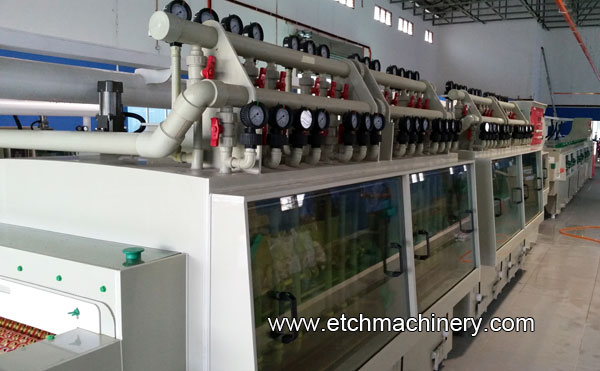
Sizing an etching line correctly is the difference between a profitable factory and one that bottlenecks at peak demand. Use the capacity formula in this guide to calculate exactly the throughput you need, with worked examples and common sizing mistakes to avoid.
The Etching Capacity Formula
Calculating the right etching line capacity is straightforward once you know the formula:
Panels/hour = (conveyor speed m/min × 60) × active chambers × utilization rate ÷ panel length m
Where:
- Conveyor speed — typically 0-6 m/min, but actual operating speed depends on etch time required
- Active chambers — 1 (single-side), 2 (double-side), 3+ (multi-stage)
- Utilization rate — 0.85-0.95 (5-15% lost to panel gaps, setup, changeovers)
- Panel length — direction of conveyor travel, typically the longer dimension
Step-by-Step Capacity Calculation Example
Let's size a line for a PCB contract manufacturer:
- Panel size: 450 × 600 mm (length = 600 mm = 0.6 m)
- Copper thickness: 35 μm, FeCl3 etchant at 50°C
- Etch time: at 50°C, etch rate is ~50 μm/min, so 35 μm takes 35/50 = 0.7 min = 42 seconds
- Chamber length: 2.0 m (typical for a 650 mm line)
- Conveyor speed: chamber length / etch time = 2.0 m / 0.7 min = 2.86 m/min → use 2.5 m/min for safety
- Panels per chamber: 2.0 m chamber / 0.6 m panel = 3.33 → round to 3 panels in chamber
- Throughput: 3 panels × (2.5 m/min × 60 / 0.6 m) = 3 × 250 = 750 panels/hr theoretical
- Realistic (90% utilization): 750 × 0.9 = 675 panels/hr
Quick Capacity Reference Table
| Line Configuration | Conveyor Speed | Throughput (450×600mm panel) | Monthly Capacity (8h × 22 days) |
|---|---|---|---|
| Single-chamber lab (GE-FET500) | Manual | 20-60 panels/hr | ~7,000 panels |
| Single-chamber conveyor (GE-S650) | 1.5 m/min | ~150 panels/hr | ~26,000 panels |
| Multi-chamber conveyor (GE-JM650) | 2.5 m/min | 300-500 panels/hr | ~140,000 panels |
| Dual-lane conveyor (custom) | 2.0 m/min | 500-800 panels/hr | ~250,000 panels |
| Full DES line (3 stages) | 1.5 m/min | 200-300 panels/hr | ~90,000 panels |
Common Sizing Mistakes (and How to Avoid Them)
- Ignoring setup and changeover time — Realistic utilization is 85-90%, not 100%. Bake this into your calculation.
- Undersizing for peak demand — Most factories see 20-30% demand variation. Size for peak, not average.
- Forgetting pre-etch (DES line developing stage) — A DES line's bottleneck is usually the developer stage, not the etcher. Make sure all stages match.
- Choosing the wrong chamber count — Single-chamber is fine for thin copper (≤17 μm). For 35-70 μm copper, you need 2-3 active chambers to ensure complete etch.
- Not planning for future capacity — A 650 mm line can be upgraded with longer chambers for higher throughput, but a 400 mm line cannot. Buy the wider conveyor even if you don't need it now.
Once you know your required capacity, the next decisions are: chemistry (FeCl3 vs CuCl2 vs alkaline), precision (HDI or standard), and budget. The etching equipment page has a side-by-side model comparison with indicative pricing. For facility planning (floor space, utilities, exhaust), see our etching line facility planning guide.
Get Expert Help Choosing the Right Etching Equipment
Tell us your material, throughput, and feature size requirement. Our engineering team responds with a tailored recommendation and price within 24 hours — no obligation.
Request Quotation