
Chemical Etching vs Laser Cutting: How to Choose for Your Part
Chemical etching and laser cutting are the two competing processes for making flat metal parts with complex 2D outlines. They look like direct competitors, but they are actually complementary — each one wins for a different part geometry, material, volume, and quality requirement. The wrong choice costs you 2–5× the part price, and the right choice is usually obvious once you look at the part.
Chemical etching and laser cutting are the two competing processes for making flat metal parts with complex 2D outlines. They look like direct competitors, but they are actually complementary — each one wins for a different part geometry, material, volume, and quality requirement. The wrong choice costs you 2–5× the part price, and the right choice is usually obvious once you look at the part.
This guide compares the two processes side by side, lays out the part geometries that each one does best, and gives a simple decision rule for picking the right one.
Quick Answer
- Chemical etching wins on: complex 2D geometry, fine features, thin foil, hard metals, burr-free edges, no heat-affected zone, low-to-medium volume, short lead time.
- Laser cutting wins on: simple 2D outlines, very thick sheet, any material (including non-metals), 3D parts, prototypes without phototool, parts with no cosmetic edge requirement.
- The two are complementary. Many production lines use both — etching for the fine details, laser for the thick and the prototype.
Chemical Etching at a Glance
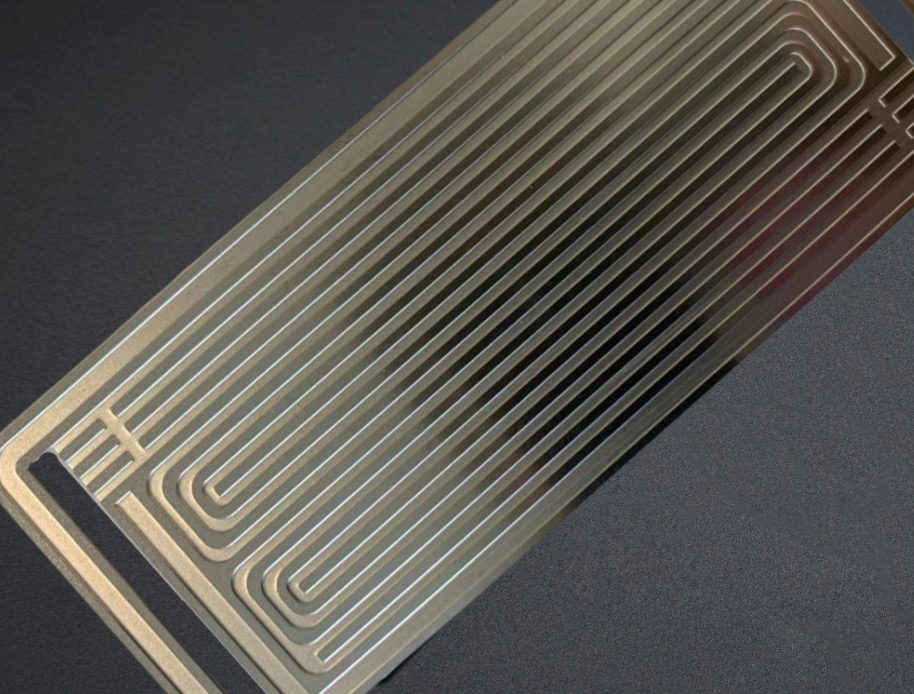
Chemical etching uses a photoresist to mask the parts of the metal sheet that should remain. The sheet is sprayed with etchant, the exposed metal dissolves, and the finished part falls out of the sheet. The whole process is chemical, not mechanical.
The three things that make etching different from any mechanical process:
- No hard tooling. A phototool is the only "tool" required. New artwork = new phototool = new part. Tooling cost is in the hundreds of dollars, not the thousands.
- No mechanical force on the part. The metal is dissolved, not cut or stamped. There is no burr, no stress, no work-hardening, and no heat-affected zone.
- Complex 2D geometry for free. A spiral, a logo, a 50 µm slot, a hexagon grid, a complex outline — all etch at the same cost as a circle.
Laser Cutting at a Glance
Laser cutting uses a focused, high-power laser beam to melt and vaporise material along a programmed path. The beam is controlled by CNC, so the cut profile is exactly the CAD file. The three common types:
- CO2 laser. The standard industrial cutting laser. Cuts non-metals (wood, plastic, leather) and thin metals (with oxygen assist). Power 30–200 W typical, cut thickness up to about 6 mm in mild steel.
- Fiber laser. The workhorse for metal cutting. The laser source is a fiber-coupled diode, more efficient than CO2 for metals. Power 1–20 kW typical, cut thickness up to 25–30 mm in mild steel with high-power models.
- Ultraviolet (UV) laser. Cold ablation, used for very fine features and heat-sensitive materials. Slower than CO2 or fiber, but the heat-affected zone is minimal.
Side-by-Side Comparison
| Factor | Chemical etching | Laser cutting |
|---|---|---|
| Tooling cost | $100–$1,000 (phototool) | $0 (no tooling) |
| Lead time (artwork to part) | 1–3 days | Same day |
| Min. feature size | 0.05–0.1 mm (foil dependent) | 0.05–0.2 mm (laser dependent) |
| Min. hole / slot | 0.1× foil thickness | 0.2–0.5× foil thickness |
| Edge taper | Vertical (slight under-etch) | 5–15° taper typical |
| Surface burr | None | Yes — recast layer + dross |
| Heat-affected zone | None | 0.05–0.5 mm depending on material and power |
| Surface chemistry change | No | Yes — oxide layer on cut edge |
| Best material thickness | 0.02–1.5 mm | 0.5–25 mm (laser dependent) |
| Hard materials (SS, Ti, hardened steel) | Easy — chemistry does the work | Hard — slow, high power, more HAZ |
| Tool wear / consumables | Etchant only | Lens, nozzle, assist gas, occasional laser service |
| 3D parts | No | Limited — some 5-axis laser cutters |
| Any material (non-metals) | No — metals only | Yes — metal, plastic, wood, leather, composite |
When Chemical Etching Wins
Etching is the right process when any of the following applies:
- Complex 2D geometry. Logos, fine mesh patterns, spiral inductors, precision filter slots, decorative panels with many small features. Laser can cut complex shapes, but the time scales with the total cut length, so a part with 1000 mm of cut takes 10× as long as one with 100 mm. Etching runs the same time for both.
- Thin foil (under 0.2 mm). Etching handles 0.05 mm foil easily, with no warping, no burr, and no HAZ. Laser cutting of foil below 0.1 mm needs careful fixturing and the part can warp from the heat of the cut.
- Hard-to-work metals. Stainless steel, titanium, beryllium copper, hardened spring steel. Etching does not care about hardness, only chemistry. Laser can cut these, but the cut is slower, the HAZ is larger, and the edge chemistry is altered.
- Burr-free or stress-free parts. Etched parts have no burr, no work hardening, no spring-back, no HAZ. Important for medical, aerospace, fuel cell, and electronics applications where the cut edge is a functional surface.
- Low to medium volume. From a single prototype to 100,000 parts, etching is usually cheaper than laser. Above 100,000 parts, the math gets closer and depends on the part geometry.
- Short lead time. New artwork in 1–3 days. Laser is faster for prototype (no phototool), but for production runs the phototool lead time is amortised over the run.
When Laser Cutting Wins
Laser cutting is the right process when any of the following applies:
- Simple 2D outline. Circle, rectangle, hexagon — no fine features, no internal cutouts. Laser is fast and accurate for simple outlines, and the cut time scales with the perimeter, not the area.
- Very thick sheet. 6–25 mm sheet is too thick to etch economically. Laser cutting, especially high-power fiber laser, handles thick sheet easily.
- 3D parts. 5-axis laser cutters can cut 3D forms. Etching is 2D only.
- Any material, including non-metals. Laser cuts metal, plastic, wood, leather, composite, ceramic. Etching is metals only.
- Single prototype, no phototool. For a single part where the phototool cost and lead time is not justified, laser is faster. Etching becomes cheaper at the second or third iteration.
- No requirement for burr-free edge. If the cut edge will be machined, ground, or hidden, the laser cut is fine. If the edge is functional or cosmetic, etching wins.
The Hybrid: Etched and Laser-Cut Together
For complex parts that need both etching and laser cutting, many production lines use both processes in sequence. The typical patterns:
- Etch the fine features, laser cut the outline. The fine internal features (a slot pattern, a logo, a mesh) are etched; the outer outline is laser cut. This combination gives the precision of etching and the speed of laser for the long cuts.
- Laser cut the prototype, etch the production. A few prototype parts are laser cut to validate the design; once the design is final, the phototool is made and the production run is etched. This avoids the phototool cost for designs that may change.
- Etch one side, laser cut the other. A part with a thin etched face and a thick structural back can be etched on the thin side and laser cut to the final outline on the thick side.
The combination is common in fuel cell bipolar plate production, filter mesh production, and high-end consumer electronics.
Cost: Etching vs Laser
The cost model is different for the two processes:
- Etching has a low per-part cost that does not scale much with complexity. The dominant cost is chemistry, which scales with sheet area. A complex part costs the same as a simple part if the area is the same.
- Laser cutting has a per-cut-length cost. The cost scales with the total cut length, not the area. A complex part with 1000 mm of cut costs 10× as much as a simple part with 100 mm of cut, even if both parts have the same area.
For parts with simple outlines and high volume, laser cutting wins on cost. For parts with complex outlines and any volume, etching wins.
Edge Quality and Tolerances
The two processes give very different cut edges:
- Etched edge: vertical, smooth, no burr, no HAZ. The sidewall has a slight under-etch (typically 5–15% of the foil thickness) but the sidewall is parallel. Tolerance on feature width is typically ±10% of foil thickness.
- Laser-cut edge: tapered (5–15°), with a recast layer and dross on the bottom edge. The HAZ is 0.05–0.5 mm depending on material and laser power. The cut surface has a different chemistry from the bulk material (oxidation, alloy element segregation). Tolerance is typically ±0.05–0.1 mm on feature width.
For functional or cosmetic edges, etching is the better choice. For edges that will be machined, ground, or hidden, laser is fine.
Choosing Between Etching and Laser Cutting?
Send us your part drawing, your material, your volume target and your lead time. Golden Eagle will quote both an etching line and a laser cutting comparison for the same part and let you see the cost difference.
Get a ComparisonConclusion
Chemical etching and laser cutting are complementary processes. Etching wins on complex 2D geometry, fine features, thin foil, hard metals, low-to-medium volume, burr-free edges, and no HAZ. Laser cutting wins on simple 2D outlines, very thick sheet, 3D parts, any material including non-metals, and single-prototype speed. Many production lines use both. The right choice depends on the part, the material, the volume, and the lead time.