
Complete guide to PCB deburring machines: how they remove copper burrs and resin smear in printed circuit board manufacturing, key specifications, and how to choose the right equipment.
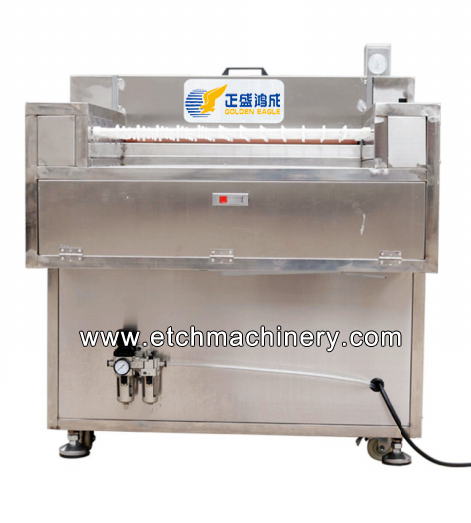
A PCB deburring machine is a specialized surface-treatment system that removes the microscopic burrs, copper slivers and resin smear left on the edge of drilled or routed printed circuit boards. These defects, if not removed, can cause solder bridges, electrical shorts and reliability failures in the finished board. Modern deburring machines combine rotating abrasive brushes, water rinse and air-knife drying in a single in-line conveyor pass.
Unlike manual deburring, an industrial PCB deburring line delivers repeatable quality on every panel — critical for high-density interconnect (HDI) and multilayer boards where the trace-to-edge spacing is below 100µm.
1. Pre-wet brushing: a water-sprayed nylon brush removes the largest burrs and copper particles from the drilled hole walls and routed edges.
2. Fine abrasive brushing: a second brush station with silicon-carbide or aluminum-oxide bristles removes the remaining resin smear and smooths the hole-wall surface.
3. High-pressure DI water rinse: removes any residual abrasive particles and chemistry from the panel surface.
4. Hot air-knife drying: a turbulent air curtain removes all water and leaves the panel dry, ready for the next process step.
Cycle time is typically 30–60 seconds per panel, depending on board thickness and number of brush stations.
Modern multilayer PCBs with laser-drilled microvias cannot tolerate any copper burr on the via wall. Even a 5µm burr can cause a short or open circuit. PCB deburring is therefore a mandatory step in aerospace, medical, automotive and 5G substrate production.
IPC-6012 and IPC-A-600 specify the maximum allowable burr height for Class 2 and Class 3 boards. An industrial deburring line consistently meets Class 3, while manual deburring can only meet Class 1.
Conveyor width: 400 / 500 / 600 / 650 mm to match your PCB panel size.
Brush type: nylon 600-grit, silicon-carbide 800-grit, or aluminum-oxide 1000-grit, depending on the board material.
Brush speed: 200–1200 RPM variable frequency drive, to handle thin cores and thick multilayer boards without damaging the copper.
Water consumption: 30–80 liters per minute for the DI rinse station.
Drying: 2–4 kW hot-air knife, 60–80°C exit temperature.
Deburring focuses on edge burrs and copper slivers, uses abrasive brushes.
Brushing focuses on surface preparation (roughening copper for better plating adhesion), uses soft nylon brushes.
Cleaning removes flux residue, dust and contamination after soldering, uses ultrasonic or spray wash.
A complete PCB surface-treatment line typically combines all three: deburring → brushing → cleaning → drying, integrated on a single conveyor with shared water recycling.
A PCB deburring machine is a must-have for any multilayer or HDI PCB production line. Choose a system with at least 2 brush stations (coarse + fine), high-pressure DI rinse, and hot-air drying. Beijing Golden Eagle supplies complete PCB deburring + brushing + cleaning + drying lines from 400 mm to 650 mm conveyor width, with CE certification and 12-month warranty.
Standard PCB deburring machines handle 0.1–6.0 mm board thickness. For thick backplanes (>6 mm) or thin flex cores (<0.1 mm), we customize the brush pressure and conveyor speed accordingly.
Yes. Our PCB deburring machines are designed for in-line integration with DES (Developing-Etching-Stripping) lines, ENIG plating lines, and HASL lines. We provide matched-height conveyors, shared DI water loop, and unified PLC control.
Brush life depends on board throughput and copper exposure. Typically 200–500 hours of continuous operation, or 2–4 weeks in a 3-shift production line. We ship a spare set of brushes with every machine.
A 500 mm conveyor PCB deburring line with 2 brush stations + DI rinse + hot-air drying starts from $12,000 USD. A 650 mm wide line with 3 brush stations, dual rinse and PLC control starts from $18,000 USD. Contact us for a quotation.