
Complete buyer's guide to PCB exposure machines in 2026. Compare UV LED vs mercury lamp vs LDI (Laser Direct Imaging) exposure machines, learn about CCD alignment, solder mask exposure, throughput, price, and find the right machine for HDI, multilaye
By Beijing Golden Eagle · Published 31 August 2026 · 14 min read
Choosing the right PCB exposure machine is one of the highest-impact capital decisions a PCB manufacturer can make. The wrong choice costs you hundreds of thousands of dollars in rework, scrapped boards, and lost customers. This 2026 buyer's guide covers everything you need to know — from the three main exposure technologies, to throughput sizing, to installation requirements, to total cost of ownership.
After 20+ years of manufacturing exposure machines for over 30 countries, we've learned what works and what doesn't. Let's walk you through the decision.
Before comparing prices and specs, you need to understand the three fundamentally different exposure technologies in use today.
Traditional exposure machines use high-pressure mercury vapor lamps that emit broad-spectrum UV light. They have been the workhorse of PCB manufacturing since the 1980s.
Verdict: Obsolete. New factories in 2026 should not buy mercury lamp machines. If you find a used one at very low cost, it might be a reasonable stop-gap, but plan to replace it within 1-2 years.
UV LED exposure machines use high-power LED arrays tuned to specific UV wavelengths (typically 365-420nm). They have largely replaced mercury lamps in new installations since 2015.
Verdict: The right choice for 90% of new PCB factories in 2026. Use UV LED for inner layer and outer layer circuit exposure, where film-based exposure is still cost-effective.
LDI exposure machines eliminate the phototool film entirely. A computer-controlled multi-lens laser array writes the pattern directly onto the photoresist, driven by a digital Gerber or ODB++ file.
Verdict: Required for HDI PCB, 5G substrate, IC substrate, and fine-pitch solder mask (bridge < 100 micron). For most multilayer and double-sided PCB factories, UV LED + film is still the most cost-effective choice. Add LDI in phase 2 when your customer base demands fine-pitch capability.
The right exposure machine depends almost entirely on what you manufacture. Here is a decision framework based on 20+ years of customer data.
For standard PCB with line/space of 100 micron (4 mil) or coarser, and minimum 8 mil (200 micron) drill:
For fine-line multilayer with 75 micron (3 mil) line/space, or any HDI structure with micro-via:
For HDI with sub-50 micron line/space, 5G communication boards, or IC substrate production, LDI is mandatory:
For flex PCB, smartphone hinges, or wearable electronics:
Throughput sizing is often misunderstood. Most factories over-buy. Here's how to think about it.
Step 1: Estimate your target annual output in square meters of PCB.
Step 2: Divide by your working days (typically 250 days/year) and shift hours (8 hours/shift) to get square meters per hour.
Step 3: Divide by your average panel size to get panels per hour.
Example: 50,000 m² / year ÷ 250 days ÷ 1 shift ÷ 8 hours = 25 m²/hour. At 0.5 × 0.5 m panels, that's 100 panels/hour. With 1 circuit exposure + 1 solder mask exposure per panel, you need 200 exposure cycles/hour = 3.3 panels/minute. This is well within the GE-UV700 capacity (5-6 panels/minute).
Buy a machine rated for 80% of your peak requirement. Why? Because:
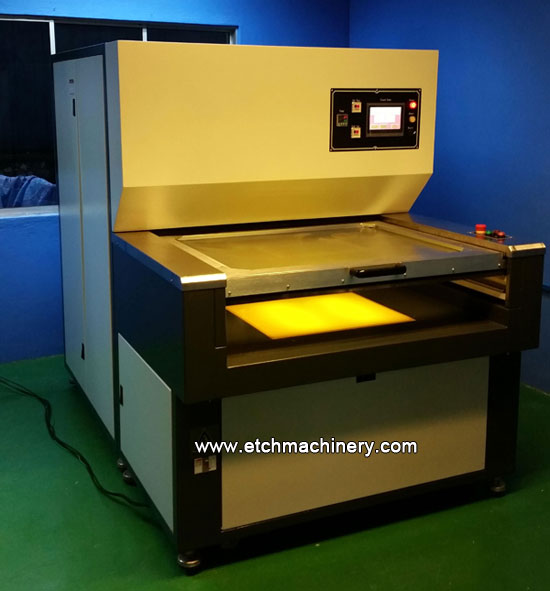
If you produce 90%+ double-sided PCB, choose a double-sided exposure machine (e.g., GE-UV700). It processes both sides simultaneously, doubling effective throughput. If you produce mostly single-sided, a single-sided machine is more cost-effective.
CCD (Charge-Coupled Device) alignment is critical for solder mask and any multilayer application where layer-to-layer registration matters.
Suitable for solder mask exposure on multilayer PCB up to 12 layers. Typical registration accuracy ± 10-15 micron. Cost: USD 60,000-100,000 for a 600x700mm machine like the GE-4CCD-LED6070.
For 16-24 layer multilayer or HDI with ± 5-8 micron registration. Cost: USD 100,000-150,000. The GE-8CCD-LED6070 is a typical 8-CCD machine.
± 12 micron layer-to-layer registration, but with filmless operation. Cost: USD 850,000+. The GE-DI8563-100ZH12 uses 12-lens parallel scanning for both high precision and high throughput.
Many buyers focus on the upfront machine price and ignore the 5-year total cost of ownership (TCO). Here's a realistic TCO breakdown for a mid-size PCB factory:
Notice the LDI has higher absolute TCO but eliminates film cost (> USD 100,000 over 5 years for a high-volume factory) and enables higher-yield fine-pitch production that often justifies the investment through pricing premium.
Most installation delays are caused by inadequate preparation of the facility. Plan these requirements before your machine arrives.
You will pay 3-5x more in electricity over 5 years, plus 10x more in lamp replacements. Buy UV LED.
Manual alignment is slow (< 10 panels/hour) and inaccurate. For 4+ layer PCB, CCD alignment is essential. Skipping it will limit your customer base.
If you produce < 5,000 m²/month of HDI, the LDI utilization will be too low to justify the USD 1M+ investment. Wait until your HDI volume justifies it, or run LDI jobs at a service center first.
Factor in 2-3 months for cleanroom build, electrical installation, and chilled water piping before the machine arrives. The most common cause of installation delay is unprepared facilities.
Even the best machine underperforms with poorly trained operators. Budget for 5-7 days of on-site training by the manufacturer's engineers. Remote video training is not enough for production-critical machines.
To receive a tailored quotation, send the manufacturer the following information:
Most manufacturers (including Golden Eagle) will respond within 24 hours with a Proforma Invoice including EXW price, lead time, payment terms, and warranty details.
For a new PCB factory in 2026, the best exposure machine depends on your product mix. For multilayer and double-sided PCB up to 24 layers, start with a UV LED exposure machine (GE-UV700) for circuit exposure and a 4-CCD alignment machine (GE-4CCD-LED6070) for solder mask. If you plan to produce HDI, 5G substrate, or fine-pitch solder mask, budget for an LDI machine (GE-DI8563-100ZH12) in your second phase.
PCB exposure machine budgets: small UV LED screen-printing units USD 8,000-15,000; standard double-sided UV LED exposure USD 25,000-50,000; 4-CCD / 8-CCD alignment exposure USD 60,000-120,000; industrial scanning exposure USD 150,000-250,000; LDI Laser Direct Imaging USD 850,000-1,200,000. Most factories start with one UV LED + one 4-CCD machine (total USD 80,000-150,000) and add LDI later.
Buy UV LED, not mercury lamp. UV LED exposure machines have 20,000-hour LED lifespan versus 1,000-hour mercury lamp, 70% lower energy consumption, instant on/off, mercury-free environmental compliance, and more consistent light output. Mercury lamp machines are obsolete for new factories in 2026.
You need an LDI machine if any of the following apply: (1) you produce HDI PCBs with line/space below 50 micron, (2) you need solder mask bridge below 100 micron for fine-pitch BGA / QFN / 0201 components, (3) you produce 5G communication boards or IC substrates, (4) you have high product mix and frequent changeover, or (5) you are experiencing rework caused by film distortion. If you only produce simple double-sided or single-sided PCBs at coarse pitch, UV LED + film is still cost-effective.
Related articles:
· UV LED vs LDI Exposure Machine: Which Should You Buy?
· How to Set Up a PCB Solder Mask Exposure Line
· All PCB exposure machines from Golden Eagle
About the author: Beijing Golden Eagle Electronic Equipment Co., Ltd. has manufactured PCB exposure machines since 2003, exporting to over 30 countries including USA, India, Vietnam, Thailand, Russia, and Germany. View the complete exposure machine lineup or LDI Laser Direct Imaging machine.