CE Certified 24h Quotation 1-Year Warranty Worldwide Delivery
Laser Plotter (Film Output) for PCB Manufacturing
A precision laser film plotter outputs high-resolution phototools for PCB imaging, FPC, liquid photoimageable solder mask, and silk-screen production. Drum-type external scanning with 400–12,000 dpi resolution and ±0.010 mm repeatability. Direct replacement for the discontinued Heidelberg Herkules / OLEC 18-5100 in a comparable price bracket.
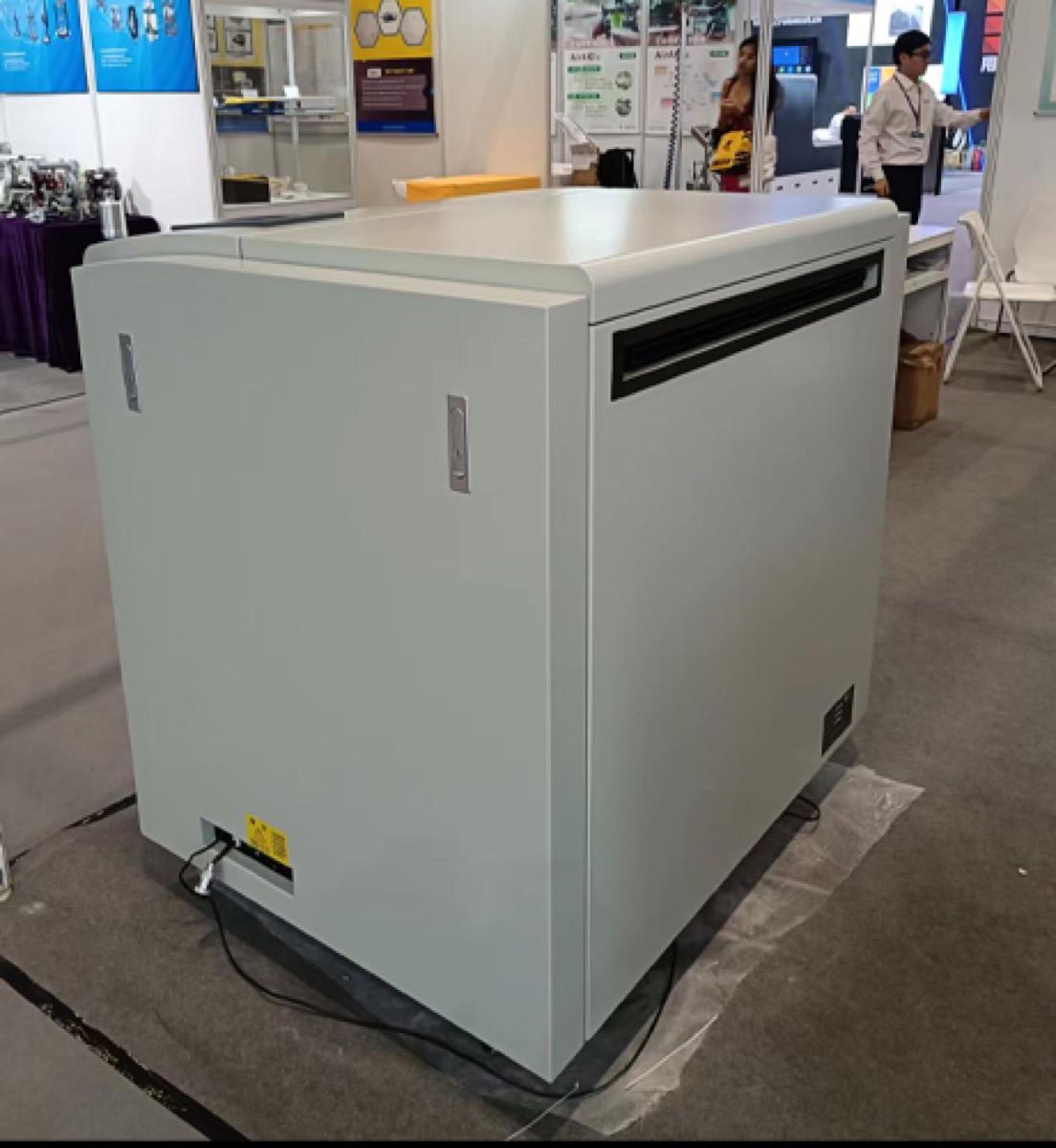
Laser plotter on the Golden Eagle trade-show floor — external drum scanning, 660 mm wide exposure.
Why Use a Laser Plotter for PCB Film Output?
A laser plotter is the dedicated equipment that produces the silver-halide phototool used in the PCB imaging step. For inner-layer and outer-layer imaging, the phototool is the master pattern that the UV exposure machine prints down onto the dry-film photoresist. A clean, dimensionally stable phototool is the foundation of a high-yield PCB line. Manual film cutting is too slow and inaccurate above 200 dpi; ink-jet phototool printers are still limited to about 2,000 dpi and use expensive consumables. A drum-type laser plotter is the industry standard at 4,000–12,000 dpi with ±0.010 mm repeatability, suitable for HDI, FPC, and IC substrate work.
How It Works
Film is mounted on the outside of a precision drum that rotates at a constant angular velocity. A focused red or near-IR laser diode (typically 650–830 nm) is moved along the axis of the drum by a linear motor. The laser is pulsed on and off at very high frequency to expose the silver-halide emulsion pixel-by-pixel. Because the film is on the outside of the drum, it never has to be bent — this gives a true 1:1 image with no distortion at the edges. After exposure, the film is processed in a standard silver-halide developer/fixer line, dried, and then used as the phototool in the UV exposure step.
Technical Specifications
Item
Specification
Exposure dimensions
508 mm × 660 mm (20″ × 26″)
Scanning resolution
400 dpi to 12,000 dpi (operator-selectable)
Scanning mode
External drum, broad-band laser scanning with high speed
Repeatability
± 0.010 mm (line & space)
Operation mode
Full automatic / half automatic / single-piece film feeding
External dimensions
1,110 mm × 840 mm × 1,200 mm
Packaging
1 wooden crate, 1,280 mm × 890 mm × 1,500 mm
Net / Gross weight
600 kg / 700 kg
Why Choose Golden Eagle?
Same supplier as your exposure and etching line. The plotter, the UV exposure machine, the developing line, and the etching machine can be supplied together, with one commissioning engineer, one warranty, and one set of spare parts.
Field-replaceable laser module. 650 nm / 830 nm laser diodes are stocked in our Beijing warehouse and ship by DHL within 3–5 days worldwide.
Calibrated to work with Golden Eagle exposure machines. The plotter and the UV exposure step are matched at the factory for 21-step exposure scale, so film output is ready for production the day the plotter arrives.
Spare film and chemistry from stock. We keep silver-halide film, developer and fixer for 5 years after sale, so you are not dependent on a third-party supplier.
Frequently Asked Questions
What is the difference between a laser plotter and an ink-jet phototool printer?
A laser plotter uses a focused laser to expose silver-halide film at 4,000–12,000 dpi, which is the industry standard for HDI and IC substrate work. An ink-jet phototool printer uses ink on transparent film and is limited to about 2,000 dpi — fine for double-side PCB but not for fine-line or substrate work. A laser plotter is also cheaper to run per square metre of film than an ink-jet, because silver-halide film is sold in bulk rolls at a much lower cost per square metre than ink-jet consumables.
What is the smallest line and space the laser plotter can produce?
With 12,000 dpi resolution (about 2.1 µm addressable) and a 25 µm laser spot, the practical limit for a 50/50 line-and-space pattern is 25 µm (1 mil) on silver-halide film. The repeatability of ±0.010 mm guarantees that 50/50 L/S patterns down to 50 µm (2 mil) hold their position across a 660 mm exposure. For 25 µm (1 mil) work the plotter needs to be paired with a collimated UV exposure machine and a high-resolution dry film.
How long does it take to plot a 508×660 mm panel?
At 4,000 dpi, a 508×660 mm panel takes 90–120 seconds. At 12,000 dpi the same panel takes 6–8 minutes. Most commercial PCB shops run at 4,000–6,000 dpi because the resolution is enough for 50/50 L/S down to 50 µm and the throughput is about 25–40 panels per hour.
Can the plotter output positive and negative films?
Yes — the operator selects positive or negative mode in the plotter software, and the laser pulses are inverted accordingly. Both modes are standard and do not require any hardware change. We supply the plotter with a Gerber-to-plot driver that accepts RS-274X and ODB++ and produces positive or negative output automatically based on the layer name.
How long does the laser module last before replacement?
A 650 nm laser diode is rated for 10,000 hours of operation. In a 2-shift commercial PCB shop, that is 5–7 years of continuous production. We recommend keeping one spare laser module in stock, and we ship spares by DHL within 3–5 days. The replacement procedure takes about 30 minutes and does not require a service engineer.