Small Chemical Etching Equipment — Bench-Top & Laboratory Etching Machine for R&D and Small-Batch Production
Quick Answer
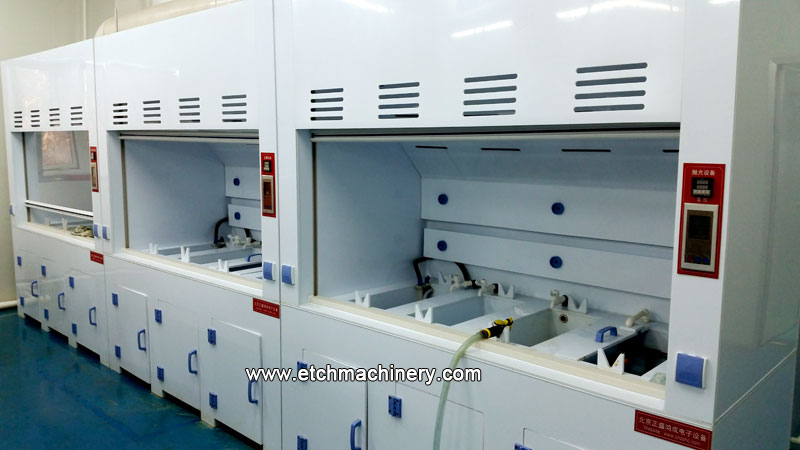
GE-SCE400 bench-top etching workstation is a compact laboratory chemical etching machine made by Beijing Golden Eagle, with a 400 mm × 300 mm working chamber that processes 1–4 panels per cycle. It supports ferric chloride (copper), nitric acid (stainless steel) and persulfate (aluminium) chemistries at 30–55 °C with PID control, achieving ~50 µm copper etch in 3 minutes and 50 µm line resolution. The standard configuration (GE-SCE400, 220 V / 50 Hz single-phase, 2 kW) is quoted at USD 8,600 EXW Beijing with a 15 L PP tank, magnetic-drive spray pump, built-in fume hood, and PLC + 7" HMI. Lead time is 15 working days. The larger GE-SCE600 (600 mm chamber) is USD 11,200 EXW. FOB Shanghai / CIF major-port shipping, OEM branding, and on-site installation training are quoted on request.
A compact, fully enclosed chemical etching workstation for laboratory R&D, sample preparation, and small-batch production. The GE-SCE400 bench-top machine processes 1–4 panels of 200 mm × 300 mm per cycle with 50 µm line resolution, ideal for universities, research institutes, and small workshops that need to produce prototype PCBs, art etchings, nameplates, and small filter meshes without committing to a full conveyor line.
GE-SCE400 bench-top etching workstation, 400 mm × 300 mm chamber, 1–4 panels per cycle.
What Is Small Chemical Etching Equipment?
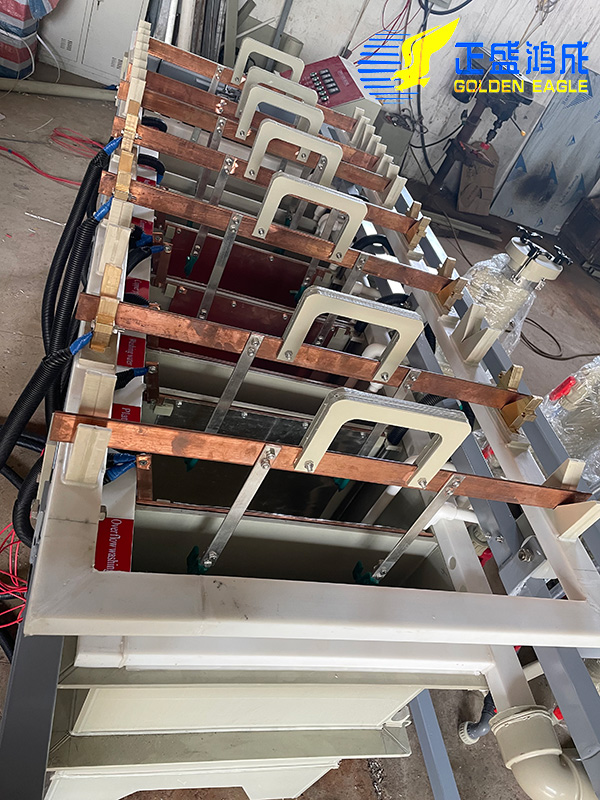
Small chemical etching equipment is a compact, fully enclosed version of a production-line etching machine. It uses the same chemistry (ferric chloride for copper, nitric acid for stainless steel, persulfate for aluminum) and the same spray-pump system, but in a bench-top form factor with a 5–15 L working tank instead of a 200–1000 L conveyor tank. The machine accepts 1–4 panels per cycle, with manual or semi-automatic loading, and recovers the etchant for re-use rather than single-pass disposal.
Small etching machines are the standard tool for: (1) university research labs making prototype PCBs and microfluidic devices, (2) art studios and craft businesses etching custom designs on copper, brass, and stainless steel, (3) small filter-mesh manufacturers producing 50–500 panels per month, and (4) PCB R&D teams iterating on a new product before committing to a production line. For a comparison with the full-size production line see our PCB etching machine and for stainless-steel art etching the nameplate & signage etching equipment.
6-Stage Etching Process
A typical small etching cycle is 6 stages: pre-clean, spray etch, rinse, neutralize, DI rinse, and hot-air dry. Each stage takes 1–3 minutes for 50 µm etch depth on copper.
01
Pre-clean.
5% NaOH or acetone wipe to remove oils, oxides, and dry-film residue from the panel surface.
02
Spray etch.
Ferric chloride 38–42°Bé at 45–50 °C, oscillating spray 30 cycles/min, 50 µm depth in ~3 min.
03
Rinse 1.
Recycle-water rinse cascade to stop the etch and recover etchant drag-out.
04
Neutralize.
5% NaOH dip for 30 s to neutralize any residual acid before final rinse.
05
DI rinse.
18 MΩ·cm DI water cascade to remove all ionic residue for downstream HASL/ENIG.
06
Hot-air dry.
60–80 °C air-knife drying to spot-free finish, ready for solder mask or surface finish.
PLC + 7″ HMI, recipe menu (10 programs), temperature & timer
Exhaust
110 mm duct, 200 m³/h extractor fan (optional)
Power supply
220 V / 50 Hz / single-phase, 2 kW
Machine dimension
900 × 700 × 1300 mm (L × W × H), bench-top
Why Choose Golden Eagle Small Etching Equipment?
Same supplier as your full-size production line. The bench-top machine uses the same chemistry, same spray-pump design, and same recipe parameters as our GE-EM production etching line. Recipes developed on the bench-top can be transferred 1:1 to the production line without re-qualification.
Fully enclosed PP body, 100 °C rated. The working tank, spray header, and exhaust manifold are all-welded PP (German), not glued PVC. Operating life 10+ years vs. 3–5 years for glued PVC tanks. The 100 °C rating allows hot-chemistry operation for fast etching of thick copper.
Magnetic-drive PP pump, no shaft seal. Traditional centrifugal pumps have a shaft seal that leaks after 6–12 months in chloride chemistry. Our magnetic-drive pump has no seal, so leakage is impossible and the pump life is 8+ years.
Recipe menu with PLC + HMI. 10 program slots, each storing chemistry, temperature, spray time, and rinse cascade. The operator loads the panel, closes the lid, presses Start, and walks away. No manual timer or temperature adjustment.
Built-in fume hood + optional HEPA. Safe to operate on a standard lab bench without external ventilation. Optional HEPA + activated-carbon filter captures acid mist and chlorine fumes, meeting EU CE and US OSHA air-quality requirements.
Frequently Asked Questions
What is the smallest line width the machine can etch?
The line resolution depends on the masking method. With photoresist (dry-film laminated and UV-exposed) we routinely etch 50 µm (0.05 mm) lines and spaces on copper, with 25 µm achievable on stainless steel with optimized spray. With vinyl-cut masking (Cricut, Silhouette) the practical limit is 100–200 µm due to the masking thickness. For sub-50 µm work, we recommend photoresist + UV exposure as the masking method; for art and craft work, vinyl cutting is faster and cheaper.
How much etchant does the machine consume per cycle?
A 4-panel cycle (200 mm × 300 mm, 35 µm copper) consumes approximately 50–100 mL of etchant drag-out into the rinse cascade. The cascade returns 60–70% of this to the working tank via the recycle pump, so net consumption is 30–40 mL per cycle. A 15 L tank of fresh ferric chloride is good for 300–500 cycles before chemistry replacement. With proper maintenance (sludge removal, Baumé adjustment, pH control), a single tank charge can last 6–12 months in a low-volume R&D lab.
Can the machine etch stainless steel or aluminum?
Yes — the GE-SCE is a multi-chemistry machine. For copper use ferric chloride (FeCl3) at 42°Bé, 50 °C. For stainless steel use a nitric-hydrofluoric acid mix (3:1 ratio, 30–40 °C) — this etches 304 and 316 stainless at ~25 µm/min and gives a clean matte finish. For aluminum use ammonium persulfate (120 g/L, 35–45 °C) — this etches 1100-series aluminum at ~30 µm/min. The tank must be thoroughly rinsed between chemistries to avoid cross-contamination; the HMI shows a chemistry-change checklist.
Is the machine safe to use in a normal laboratory?
Yes — the GE-SCE is designed for indoor lab use. The PP tank body is fully welded, the lid is interlocked with the spray pump (no spray when the lid is open), and the built-in PP fume hood captures acid mist. For full OSHA / CE compliance, we recommend adding the optional HEPA + activated-carbon filter module, which brings VOC outlet below 5 mg/m³. The operator should wear standard PPE: chemical-resistant gloves, safety glasses, and lab coat. The machine ships with a safety interlock test certificate and a CE declaration.
How long does it take to etch a 200 mm × 300 mm panel?
A full cycle (pre-clean + etch + rinse + neutralize + DI rinse + dry) takes approximately 8–10 minutes for a 35 µm copper etch on a 200 mm × 300 mm panel. The etch step itself is 3 minutes at 50 °C, 42°Bé FeCl3. The pre-clean, rinse, and dry steps add 5–7 minutes because they are sequential single-tank operations; on a production line these are parallel, which is why production lines run 3–5 m/min but bench-top machines run 1–2 cycles per hour. For 4 panels per cycle, throughput is 24–30 panels/hour in single-chemistry mode.