
Etching Machine for Jewelry: Watch, Pendant and Bracelet Etching
Jewelry and watch making is one of the oldest applications of chemical etching. The same etching machine that runs a nameplate line can also make watch dials, bracelet links, pendants, charms, belt buckles, and decorative inlays — with smaller format, finer detail, and chemistry matched to the precious or non-ferrous metal.
Jewelry and watch making is one of the oldest applications of chemical etching. The same etching machine that runs a nameplate line can also make watch dials, bracelet links, pendants, charms, belt buckles, and decorative inlays — with smaller format, finer detail, and chemistry matched to the precious or non-ferrous metal.
This guide covers the materials commonly etched for jewelry, the process flow, what machine specifications matter for small-format work, and the design rules that consistently give clean results.
Quick Answer
- A jewelry etching machine is a small-format conveyorised or batch line running ferric chloride (for copper / brass / SS) or nitric / hydrochloric acid blends (for silver and gold).
- Common materials: copper, brass, bronze, stainless steel, sterling silver, gold, sometimes titanium.
- Typical panel size: 100–300 mm wide; small-batch production, 50–5000 pieces per run.
- Detail resolution: 0.1–0.3 mm artwork features; etched sidewall quality is the standard for art and decorative work.
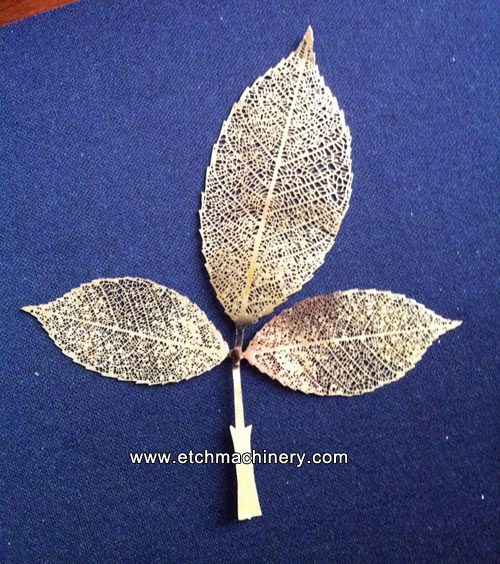
What Materials Are Etched for Jewelry?
Jewelry etching uses a wide range of metals. The most common:
- Copper. Soft, easy to etch, easy to finish. Used for costume jewelry, decorative pendants, inlay work. Etched with ferric chloride.
- Brass. Copper-zinc alloy, slightly harder than copper, holds detail well. The most common etched jewelry material. Etched with ferric chloride.
- Bronze. Copper-tin alloy, harder than brass. Used for art medals, commemorative coins, decorative plaques. Etched with ferric chloride.
- Stainless steel. Hard, durable, corrosion resistant. Used for watch cases, bracelet links, modern jewellery, and the inlay of precious metal. Etched with ferric chloride.
- Sterling silver. 92.5% silver, the most common precious metal in jewelry. Etched with dilute nitric acid or a nitric / hydrochloric blend.
- Gold (and gold alloys). Used in fine jewelry. Etched with aqua regia (nitric + hydrochloric acid) in a closed, fume-hooded setup. The etch is slow but precise.
- Titanium. Modern, lightweight, hypoallergenic. Etched with hydrofluoric acid blends — full HF safety discipline required.
Each metal has its own chemistry, etch rate, and design rules. A jewelry etching machine is often set up to run multiple chemistries, with separate sumps and rinsing for precious metal work.
The Jewelry Etching Process
The flow is the same photochemical etching process used in nameplate production, scaled to small format and high detail.
- Pre-treatment. The sheet is degreased, lightly polished and cleaned. Brass and copper sometimes get a micro-etch to give the resist better adhesion.
- Photoresist. Dry film laminated, or photosensitive ink spray-coated. For high-detail art work, screen-printed acid-resistant ink is also an option for larger features.
- Exposure. UV exposure through a high-resolution phototool. The phototool is typically 4–8000 dpi film with sharp, well-controlled line widths.
- Development. Dilute Na2CO3 for liquid resists. The artwork appears in the resist as a sharp, high-contrast image.
- Etching. Conveyorised or batch etching in the appropriate chemistry. Etch time is short (often 1–5 minutes) because the sheet is thin (typically 0.3–1.0 mm).
- Strip, rinse and dry. 10% NaOH (or appropriate stripper) to lift the resist, then rinse and air-dry.
- Finishing. Polishing, plating, stone-setting, assembly. Etched parts often go through the same hand-finishing steps as cast or stamped parts.
Jewelry Etching Machine Specifications
A jewelry etching line is typically smaller format than a nameplate line, with finer detail and the ability to swap chemistries for different metals. The key specifications:
Format and conveyor width
Jewelry parts are small. A 300 mm wide conveyor is enough for almost any jewelry work. Smaller conveyor (100–200 mm) on a benchtop machine suits artisan studios and small-batch production.
Multiple chemistry capability
A jewelry line often runs ferric chloride, nitric acid, and occasionally aqua regia or HF blends for different metals. The machine should have separate sumps, separate rinse, and the ability to swap chemistry without contamination. A small line with two sumps (one for ferrous metals, one for precious metals) is the standard configuration.
Fine spray and tight temperature control
Jewelry etching is shallow. A 0.5 mm sheet with 0.3 mm artwork needs fine flat-fan nozzles and ±1 °C temperature control. The same conveyorised line used for nameplates works, with a smaller conveyor and finer spray.
Fume handling
Nitric acid fumes are toxic. Aqua regia fumes are extremely toxic. The line needs a fume hood sized for the etch chamber and a scrubber that can handle NOx and HCl. The benchtop or small-format lines used by artisan studios can be smaller but the fume handling is no less important.
Etched vs Stamped vs Cast Jewelry
Three methods compete in jewelry manufacturing:
- Etched jewelry — photochemical process, no hard tooling, economical from a single piece to thousands, complex and detailed artwork possible. The standard for art, decorative, and limited-edition work.
- Stamped jewelry — stamping press with a die. Low unit cost at high volume, but tooling cost and lead time are high. Common for mainstream jewelry in 10,000+ piece runs.
- Cast jewelry — lost-wax casting. Best for 3D forms, less suited to flat sheet parts. Common for rings, pendants with 3D form, charms.
Etching is the right choice when the part is flat or has a 2D pattern, when the artwork is complex, when the production volume is below 10,000 pieces, and when the lead time is short. Stamping is right for very high volume of simple parts. Casting is right for 3D forms.
Design Tips for Etched Jewelry
A few design rules that consistently give good results on a jewelry etching line:
- Match artwork line width to sheet thickness. 0.3 mm line in 0.5 mm brass etches cleanly. 0.2 mm line in 0.3 mm brass is at the limit.
- Use raised features for the part surface and recessed features for inlay. Etching is a recessing process. A negative image in the artwork gives a positive image on the part.
- Always add a frame or border around the part. Etched parts without a frame are hard to handle after etch.
- Add small alignment marks for stone setting and assembly. Etched registration marks survive the polishing and plating steps and are useful for hand assembly.
- Use a herringbone or chevron for textured surfaces. A subtle etched texture on the back of a pendant, or on a bracelet link, gives a tactile finish that hand-polishing cannot.
Common Applications
Etching is used across most categories of jewelry:
- Watch parts. Dial faces, applied indices, hands, case middle components, bracelet links.
- Bracelets and bangles. Decorative panels, link components, name / monogram plates.
- Pendants and charms. Decorative panels, photo-etched portraits, monograms, religious iconography, brand logos.
- Belt buckles. Western buckles, fashion buckles, decorative buckles.
- Cufflinks and tie clips. Decorative faces, monograms.
- Medals and coins. Commemorative medals, challenge coins, decorative coins.
- Inlay work. Stainless steel bases with gold / silver inlay set into the etched recesses.
Setting Up a Jewelry Etching Line?
Send us your metal (brass, copper, SS, silver, gold), your part size and the typical production volume. Golden Eagle will configure a small-format conveyorised or benchtop line with the chemistry, fume handling and rinsing matched to your work.
Configure a LineConclusion
A jewelry etching machine is a small-format conveyorised or batch line running the chemistry matched to the metal. Etching is the right process for flat, detailed, art-quality jewelry in any volume from a single piece to thousands. The same etching line that runs a nameplate or filter mesh line can run jewelry, with the format, chemistry, and detail set up for the application.