
Last updated: 2026-08-26 · 16 min read · by Golden Eagle Engineering
PCB Etching Machine: 2026 Buyer's Guide (7 Specifications That Matter)
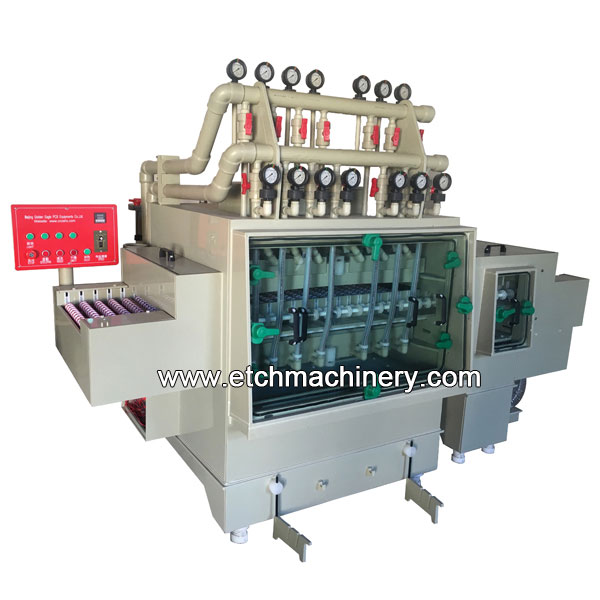
This 2026 buyer's guide is the most comprehensive resource for selecting a PCB etching machine. We cover the 7 specifications that actually matter (working width, conveyor speed, etch rate, chemistry, precision, throughput, after-sales support), compare the top manufacturers (Chinese vs European), explain the price tiers, and provide a printable comparison checklist to use with vendors.
The 7 Specifications That Actually Matter
When comparing PCB etching machine quotations, these 7 specifications will determine 90% of your production outcome. Ignore vague marketing claims and compare these numbers directly across vendors.
1. Working Width (Panel Size Capacity)
The maximum PCB panel width the conveyor can accept. Common sizes: 400 mm (lab/R&D), 650 mm (standard industrial), 1300 mm (large panel), 2500 mm (architectural). Choose ≥ your largest panel size + 50 mm clearance. Going larger than you need adds 30-50% to the price; going smaller forces you to pre-cut panels.
2. Conveyor Speed (m/min)
How fast the panel moves through the etch chamber. Standard range: 0-6 m/min, infinitely variable. Higher speed = higher throughput, but etch time drops — so for thick copper (≥35 μm) you may need slower speed. A 1.5-2.5 m/min range covers 90% of PCB applications.
3. Etch Rate (μm/min)
Material removal rate, typically 25-50 μm/min for FeCl3 on copper at 25°C, or 30-60 μm/min for CuCl2. Doubles for every 10°C increase up to ~50°C. Look for machines with temperature control (heater + chiller) — this is what separates precision etching from inconsistent etching.
4. Chemistry Compatibility
Confirm the machine supports the etchant you plan to use:
- FeCl3 (ferric chloride): general purpose, economical, low capital cost. Best for prototype and small batch.
- CuCl2 (cupric chloride): regenerable, 30-50% faster, lower chemical cost at scale.
- Alkaline ammonia: best for HDI fine-line (≤50 μm). Higher equipment cost.
- Acidic peroxide sulfate: for thin copper / flex PCB where FeCl3 leaves residue.
5. Precision / Minimum Line Width
Standard precision: ±0.02 mm to ±0.05 mm. HDI-grade: ±0.01 mm with 25 μm minimum feature. If you're etching ≥100 μm features (most industrial PCB), standard precision is fine. For HDI / flex PCB / lead frame, demand fine-line capability with documented test results.
6. Throughput (Panels/Hour)
Calculated as: panels/hour = (conveyor speed m/min × 60) / panel length m × active chambers. A standard 650 mm single-chamber line at 2 m/min with 600mm panels = ~200 panels/hour. Dual-lane configurations can reach 500+ panels/hour.
7. After-Sales Support
The hidden cost of cheap machines is downtime. Demand:
- Minimum 12-month warranty in writing
- 10-year spare parts supply commitment
- Full English operation manual + electrical schematic + P&ID
- CE Technical File and Declaration of Conformity
- Remote commissioning support via video call
- On-site engineer option with clear pricing
PCB Etching Machine Price Tiers (2026)
| Tier | Equipment | Price (USD) | Best For |
|---|---|---|---|
| 1 | Lab fume-hood etcher (GE-FET500) | $5,000 - $8,000 | R&D, prototype, lab |
| 2 | Single-chamber conveyor (GE-S650) | $5,500 - $12,000 | Small-batch PCB |
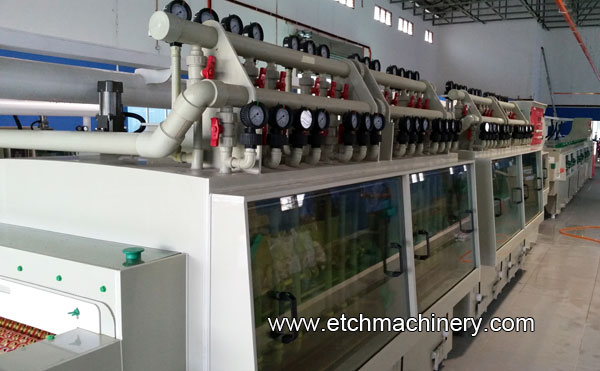
| 3 | Multi-chamber conveyor (GE-JM650) | $8,500 - $25,000 | SMB PCB production (100-300 panels/hr) |
| 4 | Alkaline HDI etcher (GE-AE650) | $11,000 - $22,000 | HDI PCB (25-50 μm) |
| 5 | Full DES line | $25,000 - $85,000 | PCB contract manufacturing |
| 6 | Turnkey line + wastewater | $50,000 - $200,000+ | Industrial scale PCB |
Free Specification Comparison Checklist (Printable)
Use this 7-point checklist when comparing vendor quotations. Request numerical answers, not marketing language.
| Spec | Your Requirement | Vendor A | Vendor B |
|---|---|---|---|
| Working width | ___ mm | ___ | ___ |
| Conveyor speed | ___ m/min | ___ | ___ |
| Etch rate (Cu, 25°C) | ___ μm/min | ___ | ___ |
| Chemistry support | FeCl3 / CuCl2 / Alkaline | ___ | ___ |
| Precision (± mm) | ___ | ___ | ___ |
| Throughput | ___ panels/hr | ___ | ___ |
| Warranty (months) | ≥12 | ___ | ___ |
| CE certified | Yes | ___ | ___ |
Get a Custom PCB Etching Machine Quotation
Provide your panel size, copper thickness, throughput target, and chemistry preference. We will recommend the optimal line and quote within 24 hours.
Request PCB Etching Quotation →Frequently Asked Questions
How much does a PCB etching machine cost in 2026?
PCB etching machines range from $5,000 for a laboratory fume-hood etcher to $200,000+ for a turnkey PCB production line with pre-treatment, post-treatment, and wastewater treatment. Conveyor spray etchers (the industry standard) cost $5,500-$25,000. Full DES (Developing-Etching-Stripping) lines start at $25,000. All prices are FOB Beijing for Golden Eagle equipment.
What is the most important specification for a PCB etching machine?
Matching the working width to your largest panel size, then verifying chemistry compatibility. Buying a machine too narrow for your panels is a common and expensive mistake — it forces pre-cutting which adds labor and material waste. Match your largest panel + 50mm clearance to the conveyor working width.
Is CE certification important for PCB etching machines?
Yes, CE certification is essential for importing into the EU and most other regions. Without CE, you cannot legally import into the EU and may face import delays, fines, or rejection. CE covers Machinery Directive 2006/42/EC, Low Voltage Directive 2014/35/EU, EMC Directive 2014/30/EU. Demand a Declaration of Conformity and full Technical File.
Chinese vs European PCB etching machine — which to buy?
Chinese machines (e.g., Golden Eagle, Jet Metal) cost 40-60% less than European equivalents (RENA, Miva, Schmid) for the same throughput. Trade-off: longer lead time (4-8 weeks vs 2-4 weeks) and potentially more limited local service. For most B2B PCB and metal etching, Chinese equipment offers the best price-performance ratio in 2026.
How long does a PCB etching machine last?
With proper maintenance, a well-built PCB etching machine lasts 10-15 years. The main wear items are: pumps (3-5 year replacement), seals and gaskets (1-2 year), conveyor belt (3-5 year), control system (10+ year, with periodic firmware updates). Buy from a manufacturer with a 10-year spare parts supply commitment.
What is the payback period for a PCB etching machine?
Payback depends on your in-house vs outsourcing cost. Typical calculation: a $50,000 PCB etching line producing 200,000 panels/year at $0.50 in-house vs $2.00 outsourced = $300,000 annual savings → payback in 2-3 months. For lower volumes (50,000 panels/year) at $0.30 vs $1.50 outsourced = $60,000 annual savings → payback in 10 months.
How do I choose between FeCl3, CuCl2, and alkaline for PCB etching?
Choose FeCl3 for prototype and small-batch (general purpose, low capital cost). Choose CuCl2 for high-volume production with regeneration (40-60% chemical cost saving). Choose alkaline ammonia for HDI fine-line PCB (25-50 μm line/space, ≤5° sidewall taper). Many factories start with FeCl3 and add CuCl2 or alkaline later.