

Last updated: 2026-08-26 · 14 min read · by Golden Eagle Engineering
Stainless Steel Etching: Process, Equipment & Cost for 304, 316 & Decorative Grades
Stainless steel etching is the standard process for producing precision nameplates, decorative panels, filter meshes, medical devices, and architectural signage. This complete guide covers material selection (304 vs 316 vs 430), FeCl3 chemistry, the 6-step process, equipment, cost, and the most common mistakes to avoid. Suitable for engineers, procurement teams, and brand owners specifying stainless steel etched components.
Stainless Steel Grades for Etching: 304 vs 316 vs 430
Choosing the right stainless steel grade is the first decision. Each grade has a different etch rate, surface finish, and corrosion resistance. Most industrial etching uses 304 (the standard) or 316 (medical/marine). 430 is a lower-cost alternative but with reduced corrosion resistance.
| Grade | EN/DIN | Etch Rate (FeCl3, 45°C) | Corrosion Resistance | Best For |
|---|---|---|---|---|
| 304 (1.4301) | X5CrNi18-10 | 28-40 μm/min | Good (indoor, dry) | Indoor nameplates, decorative panels, equipment ID tags, signage |
| 316 (1.4401) | X5CrNiMo17-12-2 | 25-35 μm/min (slightly slower) | Excellent (marine, medical, food) | Marine, medical devices, food-contact, outdoor, pharmaceutical |
| 316L (1.4404) | X2CrNiMo17-12-2 | 25-35 μm/min | Excellent (low carbon, medical) | Surgical implants, body-contact medical, pharmaceutical |
| 430 (1.4016) | X6Cr17 | 35-50 μm/min (fastest) | Fair (rusts in chloride) | Appliance panels, low-cost decorative, indoor only |
| 201 / 202 | — | 30-40 μm/min | Fair (low nickel) | Cost-driven applications, decorative, indoor |
Recommendation: Use 304 for general industrial and indoor decorative applications. Specify 316 or 316L for medical, marine, food-contact, or any outdoor use. Avoid 430 unless cost is the primary driver and the part is dry indoor only.
The 6-Step Stainless Steel Etching Process
- Material preparation. Cut sheet to final size with 5-10 mm margin. Surface must be oil-free, dry, and oxide-free. Standard sheet thickness for nameplates: 0.5-1.5 mm. For filters: 0.05-1.0 mm. For architectural panels: 1.0-3.0 mm.
- Surface cleaning & degreasing. Alkaline cleaner (5-10% NaOH at 60°C for 2-3 min) → rinse with deionized water → dry. Some factories add a light micro-etch (10-20 sec in dilute FeCl3) to improve photoresist adhesion.
- Photoresist lamination. Apply dry film photoresist (25 μm or 50 μm) at 105-115°C. For fine features (<100 μm), use liquid photoresist. For prototype, use spray coating or dip coating.
- Exposure. Expose UV light (50-150 mJ/cm²) through the artwork film. Mercury-vapor or metal-halide UV source recommended. For HDI-grade work, use collimated UV for sharpest feature resolution.
- Development. Develop in 1% sodium carbonate (Na2CO3) at 30°C for 30-60 sec. Inspect: exposed metal should be bright and clean; unexposed resist should be fully intact with no pinholes.
- Etching. Spray-etch in ferric chloride (FeCl3, 38-42°Bé) at 45-50°C. Etch time depends on desired depth (see below).
- Strip & finish. Strip resist in 3-5% NaOH at 60°C for 2-3 min → rinse → dry. Optional: color fill, protective coating, polish.
Etch Depth & Time Reference
| Target Etch Depth | Etch Time (304 SS, 45°C) | Visual Effect | Common Use |
|---|---|---|---|
| 0.02-0.05 mm | 1-2 min | Subtle, tactile | Premium brand plates, serial numbers |
| 0.05-0.10 mm | 2-4 min | Visible texture, color-fillable | Logo plates, equipment ID tags |
| 0.10-0.20 mm | 4-8 min | Strong contrast | Decorative panels, architectural signage |
| 0.20-0.30 mm | 8-12 min | Deep relief | Memorial plaques, art metalwork |
| Through-cut (0.5-1.0 mm) | 15-30 min | Full penetration | Filter mesh, shims, lead frames |
Recommended Equipment for Stainless Steel Etching
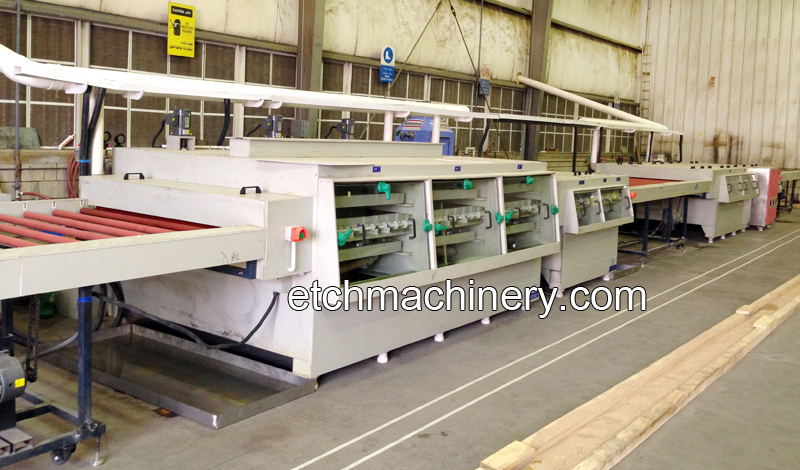
For stainless steel production, we recommend conveyor spray etchers with double-side spray, temperature control (heater + chiller), and PLC automation. Below are Golden Eagle models suitable for different volumes.
| Model | Working Width | Throughput | Indicative Price (USD) | Best For |
|---|---|---|---|---|
| GE-FET500 (lab) | 500×600 mm | 20-60 plates/hr | From $5,000 | Prototype, R&D, low-volume custom |
| GE-S650 | 650 mm | 80-250 plates/hr | From $5,500 | Small-batch nameplates, signage |
| GE-JM650 (most popular) | 650 mm | 100-300 plates/hr | From $8,500 | Mid-volume production, 304/316/430 SS |
| GE-SK9 (wide) | 650-2,500 mm | 120-350 plates/hr | From $9,800 | Architectural panels, large filter mesh |
| Double-side spray option | 650 mm | +30% throughput | +$1,500-$3,000 | Premium nameplates, double-sided plaques |
All prices are FOB Beijing and include English operation manual, CE Technical File, 12-month warranty, and 10-year spare parts supply. For a custom quotation, see our etching equipment comparison or request a quotation.
Stainless Steel Etching Cost Per Part
For a typical 50×100 mm logo plate, 0.1 mm etch depth, 304 stainless, 1.0 mm thick, at 1000-batch production:
- Material (304 SS, 1.0mm): $0.05-0.15
- Photoresist (dry film, 5% waste): $0.05-0.10
- Etchant consumption (FeCl3): $0.01-0.03
- Labor (conveyor, 200 plates/hr): $0.10-0.25
- Finishing (color fill, coating): $0.10-0.30
- Total per plate: $0.30-0.85 at 1000-batch
Common Mistakes to Avoid
- Wrong grade selection. Using 304 for marine applications causes premature rust. Use 316L for medical, food, marine.
- Etchant too cold or too hot. Below 40°C, etch rate drops sharply. Above 55°C, resist softens and sidewall quality degrades. Hold 45-50°C.
- Insufficient resist adhesion. Skipping degreasing or micro-etch causes resist to lift during etching — pinholes and ragged edges result.
- Etching too deep in one pass. For depth >0.3 mm, use multi-chamber or pause-and-rinse cycles. Deep single-pass etching causes undercut.
- Ignoring etchant regeneration. For continuous production, install an etchant regeneration skid to maintain consistent etch rate and cut chemical cost 30-50%.
Get Expert Help Choosing the Right Stainless Steel Etching Equipment
Tell us your stainless steel grade, plate size, desired etch depth, and monthly volume. Our engineering team responds with a tailored recommendation and price within 24 hours — no obligation.
Request Stainless Steel Etching Quotation →Frequently Asked Questions
Will ferric chloride etch stainless steel?
Yes. Ferric chloride (FeCl3, 38-42°Bé) at 45-50°C is the standard etchant for stainless steel. It etches 304 grade at 28-40 μm/min and 316 grade at 25-35 μm/min. The reaction produces dissolved iron and chromium salts in solution, which are then neutralized and precipitated in wastewater treatment.
What is the best etchant for stainless steel?
Ferric chloride (FeCl3) is the most common — economical, widely available, fast etch rate. Cupric chloride (CuCl2) is preferred for high-volume production with regeneration. For very fine features (<50 μm), nitric-hydrofluoric acid blends are used but require specialized equipment and safety controls.
How deep can you etch stainless steel?
Standard etch depth: 0.05-0.30 mm (for nameplates, decorative panels, signage). Maximum practical depth: 1.0-2.0 mm for thicker stainless (etch time 30-60 min, requires multi-chamber). For through-cuts in 0.5 mm sheet, 15-25 min. For 1.0 mm sheet, 30-50 min.
What stainless steel grade is best for outdoor signs?
316L (1.4404) is the best for outdoor and marine environments due to its 2-3% molybdenum content, which provides superior chloride resistance. For non-coastal outdoor use, 304 (1.4301) is usually sufficient. Avoid 430 for outdoor use — it rusts in chloride-rich environments.
Can you etch colored stainless steel?
Yes. Two common methods: (1) Etch first, then fill with enamel or epoxy paint in the etched recess and wipe clean — paint remains in recess only. (2) Etch through colored PVD titanium coating to reveal silver stainless underneath — produces a two-tone effect without paint. Both produce durable colored stainless signage.
Is stainless steel etching cheaper than laser cutting?
For thin stainless (0.1-1.0 mm) at production volumes above 500 parts, chemical etching is 60-80% cheaper per part. Reasons: 95% material utilization (vs 70-85% for laser), no per-cut time penalty at scale, lower equipment cost. For thick stainless (>3 mm) or one-off prototypes, laser is cheaper.
What is the smallest text size for stainless steel nameplate etching?
Practical minimum is 1.5-2 mm character height. Below 1.5 mm, the etched character is hard to read and difficult to color-fill cleanly. For sub-1mm text, use laser marking instead of etching. For tactile Braille text, minimum dot height is 0.2 mm with 2.5 mm dot spacing.