
Etching Machine Wastewater Treatment
Etching wastewater contains heavy metals (Cu²⁺, Fe³⁺, Ni²⁺, Cr³⁺), acids (HCl, H₂SO₄, HNO₃) or alkalis (NaOH, NH₃), and chelators. The standard treatment is two-stage chemical precipitation: (1) pH adjustment to 8 – 9 with NaOH or lime, (2) addition of flocculant (polyacrylamide) to settle metals as hydroxides. Effluent limits are typically Cu < 0.5 mg/L, Ni < 0.5 mg/L, total Cr < 1.0 mg/L, pH 6 – 9. A 1 m³/day etching line produces 5 – 20 m³ of wastewater and 30 – 100 kg of dry metal hydroxide sludge per day.
A chemical etching line is a significant wastewater generator. A 1 m³/day PCB etching line produces 5 – 20 m³ of wastewater and 30 – 100 kg of dry metal hydroxide sludge. The wastewater contains heavy metals (Cu, Fe, Ni, Cr), strong acids or alkalis, and process chemicals (chelators, surfactants, anti-foam). Untreated, this wastewater is toxic to aquatic life and can contaminate groundwater. Most countries require discharge permits and have strict limits on metal concentrations, pH, and total dissolved solids (TDS). This article covers the standard treatment process, equipment, sludge handling, and compliance requirements for China, the EU, and the US.
Etching Wastewater Composition
| Component | Source | Concentration range | Notes |
|---|---|---|---|
| Cu²⁺ | Copper etching (alkaline ammonia, cupric chloride, ferric chloride) | 100 – 5,000 mg/L | Main metal in PCB etching waste |
| Fe³⁺ | Ferric chloride etching, steel etching | 500 – 50,000 mg/L | Often the highest concentration in PCB etching waste |
| Ni²⁺ | Nickel plating rinse, electroless Ni | 10 – 500 mg/L | Restricted in many jurisdictions |
| Cr³⁺ / Cr⁶⁺ | Chrome plating rinse (rare in modern etching) | 0 – 100 mg/L | Cr⁶⁺ is highly toxic; requires separate treatment |
| Free acid (H⁺) | Acid etching (FeCl₃, CuCl₂, HCl) | pH 0 – 2 | Needs neutralization |
| Free alkali (OH⁻) | Alkaline etching (NH₃, NaOH) | pH 10 – 14 | Needs neutralization |
| NH₃ / NH₄⁺ | Alkaline ammonia etching | 100 – 5,000 mg/L | Can be stripped and re-used |
| Cl⁻ | Cupric chloride, ferric chloride | 5,000 – 100,000 mg/L | High — limits water re-use |
| Chelators (EDTA, NH₃) | Alkaline ammonia etching | 50 – 1,000 mg/L | Make metals hard to precipitate |
| Surfactants | Cleaning, rinsing | 10 – 100 mg/L | Foaming in treatment |
| TDS (total dissolved solids) | All of the above | 5,000 – 100,000 mg/L | High — limits direct discharge |
Standard Wastewater Treatment Process
The standard treatment process for etching wastewater is two-stage chemical precipitation with intermediate pH adjustment. The flow is:
Stage 1: Equalization and pH Adjustment
Wastewater from the etching line and rinses flows into an equalization tank (10 – 50 m³, 12 – 24 h retention). The equalization tank homogenizes the flow and pH. Lime (Ca(OH)₂) or sodium hydroxide (NaOH) is added to raise the pH to 8 – 9. At this pH, most heavy metals start to precipitate as hydroxides.
pH and metal precipitation
- pH 7 – 8: Fe(OH)₃ precipitates (most iron removed)
- pH 8 – 9: Cu(OH)₂ precipitates (most copper removed)
- pH 9 – 10: Ni(OH)₂ and Cr(OH)₃ precipitate (nickel and chrome removed)
- pH > 10: amphoteric metals (Al, Cr, Zn) start to re-dissolve — do not exceed pH 10
- Optimal for mixed metal waste: pH 8.5 – 9.5
Stage 2: Coagulation and Flocculation
A coagulant (typically ferric chloride or polyaluminum chloride, PAC) is added to neutralize the negative charge on colloidal particles, allowing them to aggregate. A flocculant (typically anionic polyacrylamide, 0.5 – 2 mg/L) is then added to form large, fast-settling flocs. The flocs settle in a clarifier (1 – 4 h retention), producing a clarified supernatant and a metal-hydroxide sludge.
Stage 3: Sludge Thickening and Dewatering
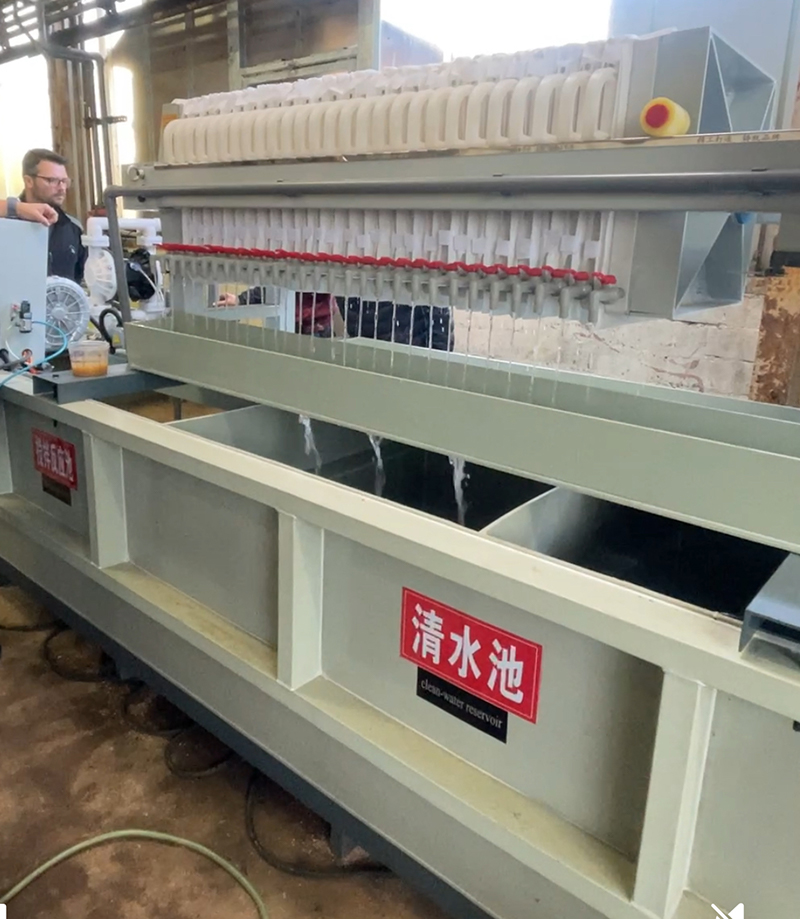
The sludge from the clarifier is 1 – 3 % solids. It is thickened in a gravity thickener to 4 – 6 % solids, then dewatered with a filter press or centrifuge to 25 – 35 % solids (a wet cake). The cake is sent to a hazardous-waste facility for stabilization (usually with cement or fly ash) and landfilling, or for metal recovery (smelting).
Stage 4: Polishing (Optional)
The clarifier supernatant is polished with a sand filter or membrane filter to remove residual suspended solids (< 5 mg/L). For very strict discharge limits (Cu < 0.1 mg/L), ion exchange or reverse osmosis is added after the clarifier.
Wastewater Treatment Equipment
| Equipment | Function | Capacity | Notes |
|---|---|---|---|
| Equalization tank | Homogenize flow and pH | 10 – 50 m³ | 12 – 24 h retention, with mechanical mixer and air sparger |
| pH adjustment tank | Add lime or NaOH to pH 8 – 9 | 5 – 20 m³ | Inline pH probe and PID-controlled dosing pump |
| Coagulation tank | Add PAC or ferric chloride | 5 – 20 m³ | Mixing time 1 – 5 min, G-value 200 – 500 s⁻¹ |
| Flocculation tank | Add polyacrylamide flocculant | 10 – 30 m³ | Slow mixing 15 – 30 min, G-value 30 – 80 s⁻¹ |
| Clarifier | Settle metal hydroxide flocs | 20 – 100 m² | 1 – 4 h retention; produces clarified supernatant and 1 – 3 % sludge |
| Sludge thickener | Concentrate sludge | 10 – 50 m² | Gravity, 4 – 6 h retention, 4 – 6 % solids out |
| Filter press | Dewater sludge | 5 – 50 m² filter area | Batch, 25 – 35 % dry cake |
| Sand filter | Remove residual suspended solids | 5 – 20 m³/h | Backwash every 8 – 24 h |
| Activated carbon filter | Remove residual organics | 5 – 20 m³/h | Replace carbon every 3 – 6 months |
Effluent Compliance — China, EU, US
| Parameter | China GB 8978-1996 (Class 1) | EU 2020/2184 (drinking water) | US EPA (metal finishing 40 CFR 433) |
|---|---|---|---|
| pH | 6 – 9 | 6.5 – 9.5 | 6 – 9 |
| Cu (total) | 0.5 mg/L | 2.0 mg/L | 2.07 mg/L (daily max) |
| Ni (total) | 1.0 mg/L | 0.02 mg/L (drinking water guideline) | 2.38 mg/L (daily max) |
| Cr (total) | 1.5 mg/L | 0.05 mg/L (Cr VI) | 0.57 mg/L (Cr VI, daily max) |
| Zn | 2.0 mg/L | — | 1.48 mg/L (daily max) |
| Fe | — | 0.2 mg/L | — |
| NH₃-N | 15 mg/L | 0.5 mg/L | — |
| TDS | 1500 mg/L (Class 1) | — | — |
| COD | 100 mg/L | — | — |
| SS (suspended solids) | 70 mg/L | — | 30 mg/L (daily max) |
| F (fluoride) | 10 mg/L | 1.5 mg/L | — |
Sludge Handling and Metal Recovery
The metal hydroxide sludge is a hazardous waste in most jurisdictions. Two main disposal routes:
- Stabilization and landfilling. The most common route. Sludge is mixed with cement or fly ash at 1:1 to 1:3 ratio, formed into a solid block, and landfilled in a hazardous-waste facility. Cost is typically 200 – 500 USD per ton of dry sludge in China, 500 – 1,500 USD per ton in the EU.
- Metal recovery by smelting. More environmentally friendly but only viable at high metal concentrations. Copper-rich sludge can be smelted to recover 60 – 80 % of the copper as crude copper. Iron-rich sludge (from ferric chloride etching) is usually not recovered — it goes to landfill. The recovered metal offsets part of the disposal cost.
- Sludge-to-pigment route. Iron hydroxide sludge can be calcined at 600 – 800 °C to produce iron oxide pigment (Fe₂O₃, red; Fe₃O₄, black). Used in construction materials. This is a niche route, ~ 5 % of total sludge.
Common Wastewater Treatment Problems
| Problem | Cause | Fix |
|---|---|---|
| Cu in effluent > 0.5 mg/L | pH too low (< 8); chelators (NH₃, EDTA) holding Cu in solution | Raise pH to 9; add sulfide (Na₂S) for chelator-bound Cu; or add ion exchange |
| Foaming in clarifier | Surfactants from cleaning; high aeration | Add anti-foam; reduce aeration; use coagulant first |
| Sludge does not settle | Flocculant dose too low; pH wrong; chelators | Increase flocculant dose; check pH; add sulfide for chelators |
| High sludge volume | Low sludge solids in clarifier; high water content | Check clarifier underflow; add thickening step before dewatering |
| Cr⁶⁺ in effluent (if chrome plating) | Not reduced to Cr³⁺ before precipitation | Add sodium bisulfite (NaHSO₃) reducer at pH 2 – 3, then raise pH to 8 – 9 for precipitation |
| NH₃-N in effluent | Alkaline ammonia etching not stripped | Install ammonia stripper (pH 11, steam at 100 °C) before precipitation |