
How to Make a Nameplate and Sign: Photochemical Etching Process Guide
A nameplate or sign is made by (1) CAD design of text, logo, and cut profile, (2) high-resolution photo-tool on film, (3) cleaning and dry-film photoresist lamination onto a stainless steel, brass, or aluminum sheet, (4) UV exposure through the photo-tool to harden selected areas, (5) developing to wash off unhardened resist, (6) spray etching with ferric chloride (FeCl3 for steel/aluminum) or nitric-hydrochloric acid (for brass), (7) stripping the resist and color-fill painting for visible text, and (8) oven-curing and final QC. A 600 x 400 mm sheet produces 50-200 small nameplates in one etching run.
A metal nameplate or sign is one of the most visible products of any factory, building, or piece of equipment. Asset tags, equipment ID plates, lobby signage, building directories, and outdoor advertising signs are all made by the same photochemical etching process that makes printed circuit boards. Despite how common they are, most nameplates go through the same 7-step process — and the only difference between a $5 asset tag and a $500 architectural sign is the metal, the size, and the color fill.
Key Takeaways
- Nameplates and signs are made by photochemical etching of metal sheet, not by laser or mechanical engraving.
- Standard material is 1.0 mm stainless steel 304 for industrial, brass for premium, anodized aluminum for lightweight signs.
- Etching chemistry is 42-45 °Bé ferric chloride (FeCl3) for steel/aluminum, nitric-HCl aqua regia for brass.
- Color fill uses UV-cured epoxy paint screen-printed into the etched recesses, then oven-cured.
- A typical small nameplate costs USD 0.50-3.00 at 100+ batch; an architectural sign USD 50-300.
What Is a Nameplate / Sign?
A nameplate is a metal plate with raised or recessed text, logos, model numbers, serial numbers, or other identifying information, attached to a piece of equipment, a wall, or a building. A sign is the larger, often outdoor, version of the same product — lobby directories, building signs, billboards, directional signs. The same equipment and process makes both.
Modern nameplates are typically stainless steel 304 (most common for industrial), brass (premium look for hotels, plaques, awards), or anodized aluminum (lightweight for outdoor signs and consumer products). Thickness is usually 0.5-1.5 mm. The text and graphics are created by chemically etching recesses into the metal, then filling the recesses with colored paint or leaving them as bare metal. Some nameplates add raised borders by etching a recess around the perimeter and a second recess around the inner border, leaving the border raised.
Etched nameplates are the standard for industrial equipment, marine, aerospace, and outdoor signage because they resist scratching, weather, chemicals, and UV better than printed labels. A well-made etched stainless steel nameplate lasts 20+ years outdoors and is virtually indestructible in normal use.

Materials: Stainless Steel, Brass, Aluminum
The right material choice depends on the application environment, expected lifespan, and visual requirements. The four standard materials are below.
| Material | Thickness | Cost Index | Lifespan | Best Use |
|---|---|---|---|---|
| Stainless steel 304 (most common) | 0.5-1.5 mm | 1.0× | 20+ years | Industrial equipment ID, asset tags, outdoor signs |
| Stainless steel 316 | 0.8-1.5 mm | 1.6× | 25+ years | Marine, chemical plant, coastal outdoor |
| Brass (H62 / H68) | 0.8-1.5 mm | 1.8× | 30+ years (with patina) | Premium plaques, hotel signs, awards, retail |
| Anodized aluminum 5052 | 0.5-2.0 mm | 0.6× | 10-15 years | Lightweight signs, consumer products, full-color graphics |
| Aluminum (raw, unanodized) | 0.5-1.0 mm | 0.4× | 5-8 years | Self-adhesive labels, indoor signs |
| Copper / bronze | 0.8-1.2 mm | 2.4× | 40+ years | Architectural and heritage applications |
For most industrial applications, stainless steel 304 at 1.0 mm thickness with a 2B (matte) or BA (bright annealed) finish is the default. The 2B finish is the cheapest and gives a slight grain that hides minor surface scratches; the BA finish is mirror-bright and shows every scratch but looks premium. For marine and coastal outdoor applications, upgrade to 316 stainless or use marine-grade anodized aluminum. For premium indoor signs, brass gives a warm gold look that improves with age as it patinas.
The 7-Step Manufacturing Workflow
Nameplates are made by photochemical etching — the same 7-step process used for printed circuit boards and flexible cutting dies. Each step has its own machine and chemistry. Skipping a step is possible for prototypes but commercial quality requires each step to be properly controlled.
| # | Step | Process | Machine | Time |
|---|---|---|---|---|
| 1 | CAD design | Layout text, logo, borders, holes, mounting slots in CAD at 1:1 | CAD software | 30-60 minutes |
| 2 | Photo-tool | Plot 1:1 artwork on high-resolution film at 4000 dpi minimum | Film plotter or image-setter | 10-20 minutes |
| 3 | Sheet preparation | Cut metal sheet to working size, deburr edges, degrease | Sheet cutter + cleaning line | 10-20 minutes |
| 4 | Photoresist | Laminate dry-film photoresist onto both sides of sheet | Dry-film laminator | 10-15 minutes |
| 5 | Exposure | UV expose through photo-tool; hardened areas remain, soft wash off | UV LED exposure machine (4-CCD aligned) | 30-60 seconds |
| 6 | Developing | Spray sodium carbonate to wash off unhardened resist | Spray developing machine | 1-3 minutes |
| 7 | Etching | Spray FeCl3 (steel/aluminum) or aqua regia (brass) to dissolve exposed metal | Conveyor spray etching machine | 15-45 minutes |
| 8 | Stripping + color fill + finishing | Strip resist, color fill recesses, oven-cure, QC, mount | Stripping tank + screen printer + oven | 1-2 hours |
Total active production time for a single nameplate is 2-4 hours. A 600 x 400 mm sheet produces 50-200 small nameplates in one etching run, with each subsequent nameplate from the same sheet requiring only the final cutting-and-finishing step.
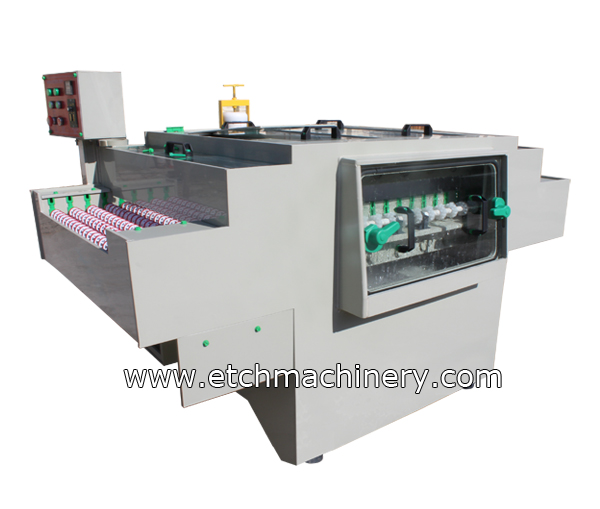
Etching Chemistry by Material
Different metals need different etchants:
- Stainless steel 304/316: 42-45 °Bé ferric chloride (FeCl3) at 35-45 °C, spray pressure 2-3 bar. Etch rate 25-35 µm/min. Adds about 5-8° sidewall taper.
- Brass (H62 / H68): Nitric-hydrochloric acid mixture ("aqua regia light") at 25-30 °C. Etch rate 40-60 µm/min. Need good fume scrubbing.
- Anodized aluminum 5052: Sodium hydroxide (NaOH) solution at 50-60 °C, OR ferric chloride at 38-42 °Bé. Etch rate 30-50 µm/min.
- Copper / bronze: 38-42 °Bé ferric chloride (FeCl3) at 30-40 °C.
Color Fill: Paint vs Ink vs Epoxy
Color fill is what makes the etched recesses of a nameplate visible. Without color fill, the nameplate is just brushed metal with shallow recesses. The three common fill approaches are below.
| Fill Method | Durability | Cost Index | Best Use |
|---|---|---|---|
| UV-cured epoxy paint | Excellent (10+ years outdoors) | 1.5× | Industrial / outdoor nameplates |
| Air-dry enamel paint | Good (5-7 years) | 0.6× | Indoor signs, retail |
| Two-part epoxy paint | Very good (8-10 years) | 1.2× | High-end industrial |
| Epoxy screen-printing ink | Excellent (10+ years) | 1.8× | Mass production / precise color |
| Vinyl overlay insert | Limited (UV-fades) | 0.4× | Cheap short-run signs |
| No fill (bare metal recess) | Permanent (no fill to fade) | 0× | Architectural, premium |
Color fill is applied by screen printing: the etched sheet is placed on a screen printer, paint is forced into the recesses through the screen mesh, and the sheet is oven-cured or UV-cured. Most production nameplates use 1-2 colors (e.g. black text on brushed steel); 4-color process printing is possible for full-color signs on aluminum. Curing is critical: under-cured paint peels in weeks; over-cured paint discolors; the standard cycle is 30 minutes at 160-180 °C for oven-cure, or 8 seconds under a 365 nm UV-LED for UV-cure.
Etching vs Engraving vs Printing
There are three ways to put text and graphics on a metal nameplate. They are not interchangeable.
| Parameter | Photochemical Etching | Laser Engraving | Mechanical Engraving |
|---|---|---|---|
| Min line width | 0.1 mm | 0.05 mm | 0.5 mm |
| Min font size | 4 pt | 3 pt | 10 pt |
| Per-piece cost (single) | USD 5-30 | USD 2-10 | USD 5-25 |
| Per-piece cost (100 batch) | USD 0.50-3 | USD 2-10 | USD 3-15 |
| Per-piece cost (1000 batch) | USD 0.20-0.80 | USD 2-10 | USD 3-15 |
| Lead time | 2-4 hours per piece | 10-30 min per piece | 10-30 min per piece |
| Color fill capability | Excellent | Difficult (heat-affected zone) | Difficult |
| Outdoor durability | Excellent (etched recess) | Good (recess but laser darkens edges) | Good |
Use photochemical etching when: batch size is 50+ pieces, you need fine text and graphics, color fill is required, and per-piece cost matters.
Use laser engraving when: batch is 1-10 pieces, you need very tight tolerance, or you're prototyping a new design before going to mass production.
Use mechanical engraving when: only a few pieces are needed and you don't have an etching line.
Cost and Cycle Time
Nameplate economics are dominated by tooling cost (photo-tool) and per-piece labor. The table below models a typical commercial nameplate operation.
| Cost Driver | Single Piece | Batch of 100 | Batch of 1,000 |
|---|---|---|---|
| CAD + photo-tool | USD 20-50 | USD 20-50 (amortized 0.2-0.5/pc) | USD 20-50 (amortized 0.02-0.05/pc) |
| Metal sheet (1.0 mm SS304) | USD 0.50-2 | USD 0.30-1.5 | USD 0.20-1 |
| Photoresist + etchant | USD 1-2 | USD 0.5-1 | USD 0.2-0.5 |
| Etching chemistry + utilities | USD 1-3 | USD 0.5-1.5 | USD 0.3-0.8 |
| Color fill paint + cure | USD 1-3 | USD 0.3-1 | USD 0.15-0.5 |
| Labor (3 hours, USD 8/hr) | USD 24 | USD 8 (amortized) | USD 3 (amortized) |
| Finishing + QC + mounting | USD 5 | USD 2 | USD 0.5 |
| Total per piece | USD 52-87 | USD 32-64 | USD 24-56 |
| Total batch | USD 52-87 | USD 3,200-6,400 | USD 24,000-56,000 |
A typical small industrial nameplate (40 x 80 mm, stainless steel 1.0 mm, 1 color fill) costs USD 0.50-3.00 at 100+ batch size; an architectural lobby sign (600 x 400 mm, brass 1.5 mm, 2 color fill + raised border) costs USD 80-300 each. Lead time from approved artwork to finished nameplate is one 8-hour shift; rush orders can be turned in 1-2 hours with a pre-made photo-tool.
Industry Applications
Nameplates and signs serve almost every industry that uses equipment, machinery, or buildings. The five largest end-uses are below.
Equipment ID & Asset Tags
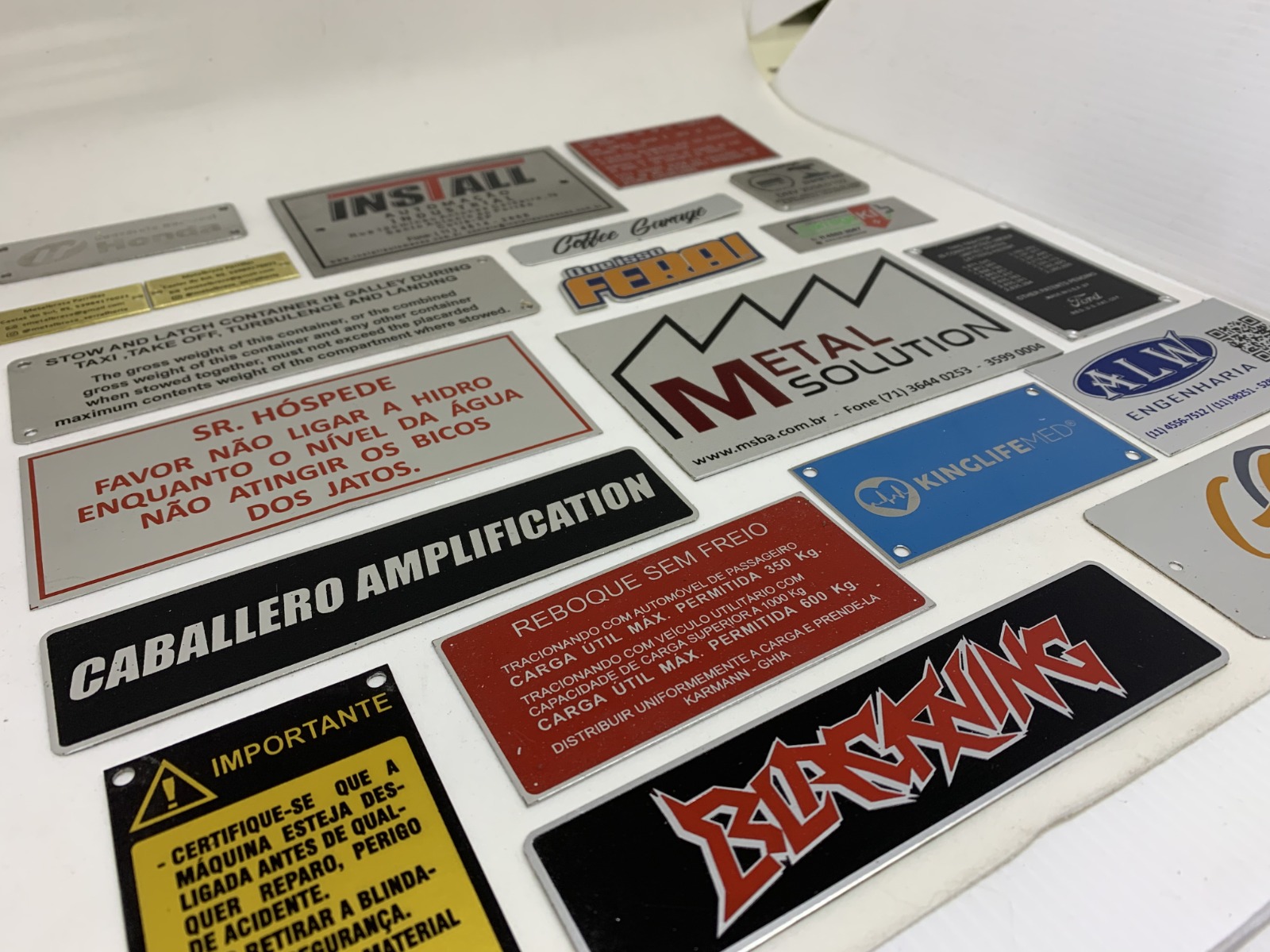
The largest nameplate market: equipment ID plates, asset tags, serial number plates, model number tags, and CE/UL certification labels. Standard material is 1.0 mm SS304, often with 1-2 color fill.
Architectural Signage
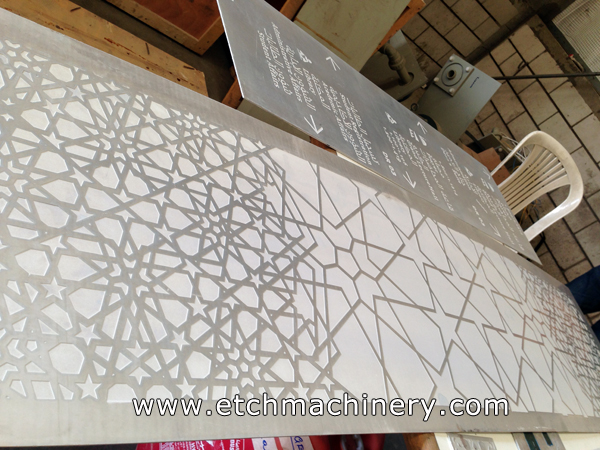
Lobby signs, building directories, room numbers, wayfinding signs, and elevator panels. Premium materials: brass, bronze, anodized aluminum. Often 2-4 color fill and raised borders.
Outdoor & Wayfinding Signs
Building signs, directional signs, parking lot signs, traffic signs. Marine-grade 316 stainless or anodized aluminum for 20+ year outdoor life. Often 1-2 colors.

Plaques & Awards
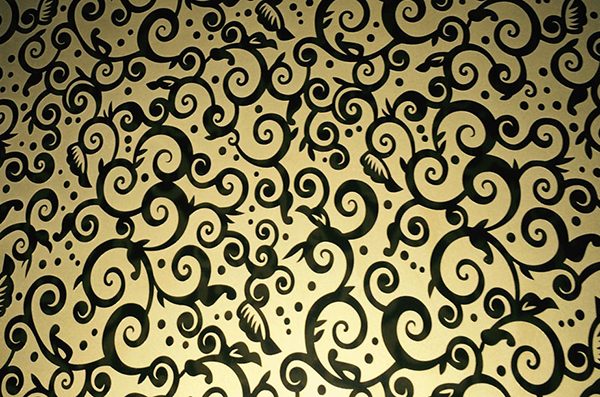
Recognition plaques, dedication plaques, awards, hotel signage. Highest-end materials: brass, bronze, polished stainless. Custom logos and typography.
Medical Device Labels
FDA-compliant device labels, sterile packaging inserts, and medical equipment ID. Biocompatible inks, cleanroom-compatible production, validation documentation.
Golden Eagle Equipment Lineup
Beijing Golden Eagle supplies complete nameplate and sign manufacturing lines covering every step of the 7-step process. The lineup below is the standard 8-12 machine scope for a 100-500 nameplate/day or 20-100 sign/day capacity line.
Nameplate & Sign Production Equipment
Production equipment used in the nameplate and sign manufacturing workflow:
-
 Step 3
Sheet Cutting Machine
GE-SC650, 0.5-1.5 mm metal sheet
-
Step 7
S650 Double-Side Etching Machine
GE-S650, 650 mm width, dual-side
-
 Step 7 (Alt)
Nameplate Etching Machine
GE-NE650, conveyor spray
-
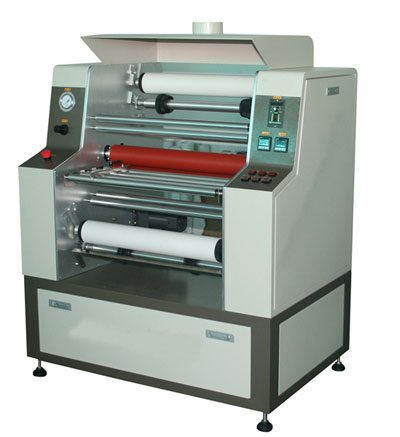 Step 4
Dry Film Photoresist Laminator
GE-DRL series, 400-650 mm
-
 Step 5
UV Exposure Machine
GE-B2, ±0.02 mm alignment
-
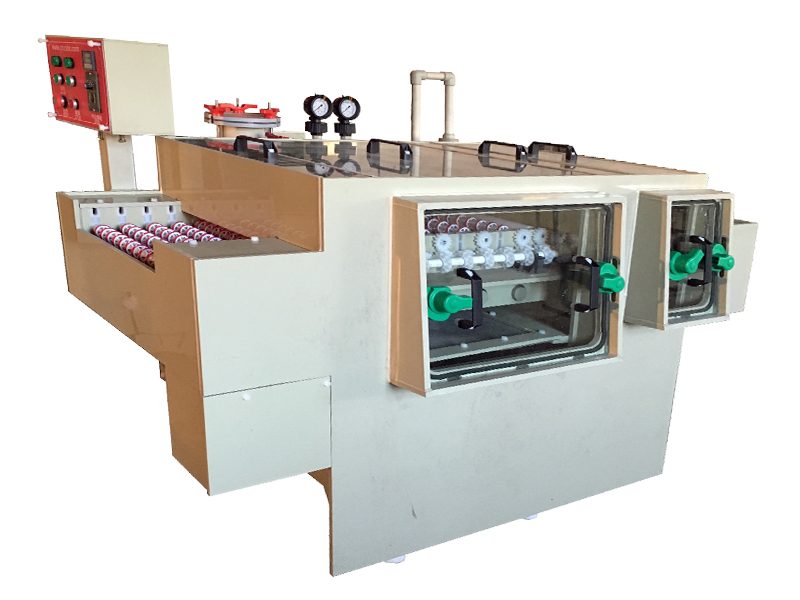 Step 6
Spray Developing Machine
GE-D650W, sodium carbonate
-
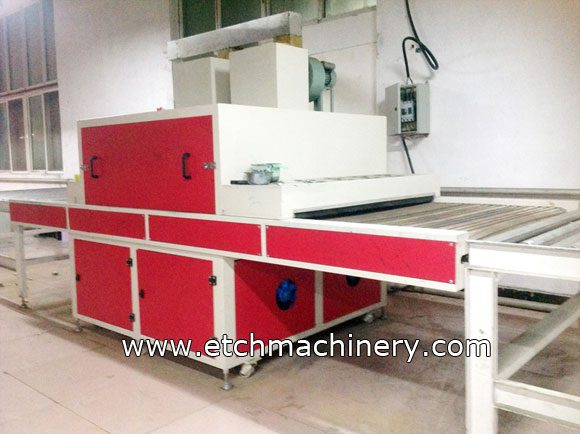 Step 8
UV Curing Machine
GE-UV365C, paint cure
Frequently Asked Questions
How are metal nameplates made?
Metal nameplates are made by photochemical etching: (1) CAD design with text, logo, and cut profile, (2) high-resolution photo-tool on film, (3) cleaning and photoresist lamination onto a stainless steel, brass, or aluminum sheet, (4) UV exposure through the photo-tool, (5) developing to reveal unprotected metal, (6) spray etching with 42-45 °Bé ferric chloride (FeCl3) or nitric acid for brass, (7) stripping and color fill or paint fill, and (8) finishing, mounting, and QC. Cycle time per nameplate is 2-4 hours; a 600 x 400 mm sheet produces 50-200 small nameplates in one etching run.
What is the best metal for outdoor signs?
For outdoor signs, 304 stainless steel (most common), 316 stainless steel (marine/coastal), anodized aluminum (lightweight, full-color graphics), and brass (premium look) are the standard materials. Stainless 304 lasts 20+ years outdoors; aluminum 10-15 years; brass 30+ years with patina. For chemical-plant or marine environments, use 316 stainless or marine-grade anodized aluminum.
What is the difference between etching and engraving for signs?
Etching dissolves metal in exposed areas to create recessed text and graphics — best for large production runs, complex logos, fine detail down to 0.1 mm line widths, and color-fill applications. Engraving cuts the metal with a rotary cutter or laser — best for one-offs, prototypes, and thicker metals. Etching cost is lower per part in batches of 100+; engraving is faster for 1-10 pieces. Etching gives clean burr-free edges that accept paint evenly; engraving leaves sharp burrs that need deburring.
How long does it take to make a nameplate?
A single small nameplate takes 2-4 hours of active production time: 30-60 minutes for CAD design and photo-tool, 30-45 minutes for sheet preparation and lamination, 60-90 minutes for exposure and developing, 30-60 minutes for etching, 30-45 minutes for color fill and finishing. A batch of 100 small nameplates from one sheet takes the same 2-4 hours; per-piece time drops to 1-2 minutes. Rush orders can be turned in 1-2 hours with a pre-made photo-tool.
What is color fill in a nameplate?
Color fill is the process of filling the etched recesses of a nameplate with colored paint or enamel to make text and graphics stand out from the metal background. Standard colors are black, white, red, blue, and yellow; custom Pantone colors are possible. Color fill is done by screen-printing paint into the etched recesses, then oven-curing or air-drying. UV-cured epoxy paint gives the best scratch resistance for outdoor and industrial nameplates.
How thick should a metal nameplate be?
Standard nameplate thickness is 0.5-1.5 mm for stainless steel, 0.8-1.5 mm for brass, and 0.5-1.0 mm for aluminum. Thinner metal (0.3-0.5 mm) is for self-adhesive labels that bend around curved surfaces; thicker metal (1.5-3.0 mm) is for heavy industrial nameplates with raised borders. The most common industrial standard is 1.0 mm stainless steel 304 with a 2B or BA finish for etched and color-filled nameplates.
Can Golden Eagle supply nameplate and sign etching equipment?
Yes. Beijing Golden Eagle supplies conveyor spray etching machines for nameplate and sign production (GE-NE650, 500-650 mm width; GE-NE850, 800 mm width for large signs), as well as complete production lines with CAD-CAM, photoresist lamination, exposure, developing, etching, color filling, and finishing equipment. Lines ship in 90-150 days with on-site installation, training and lifetime support.